
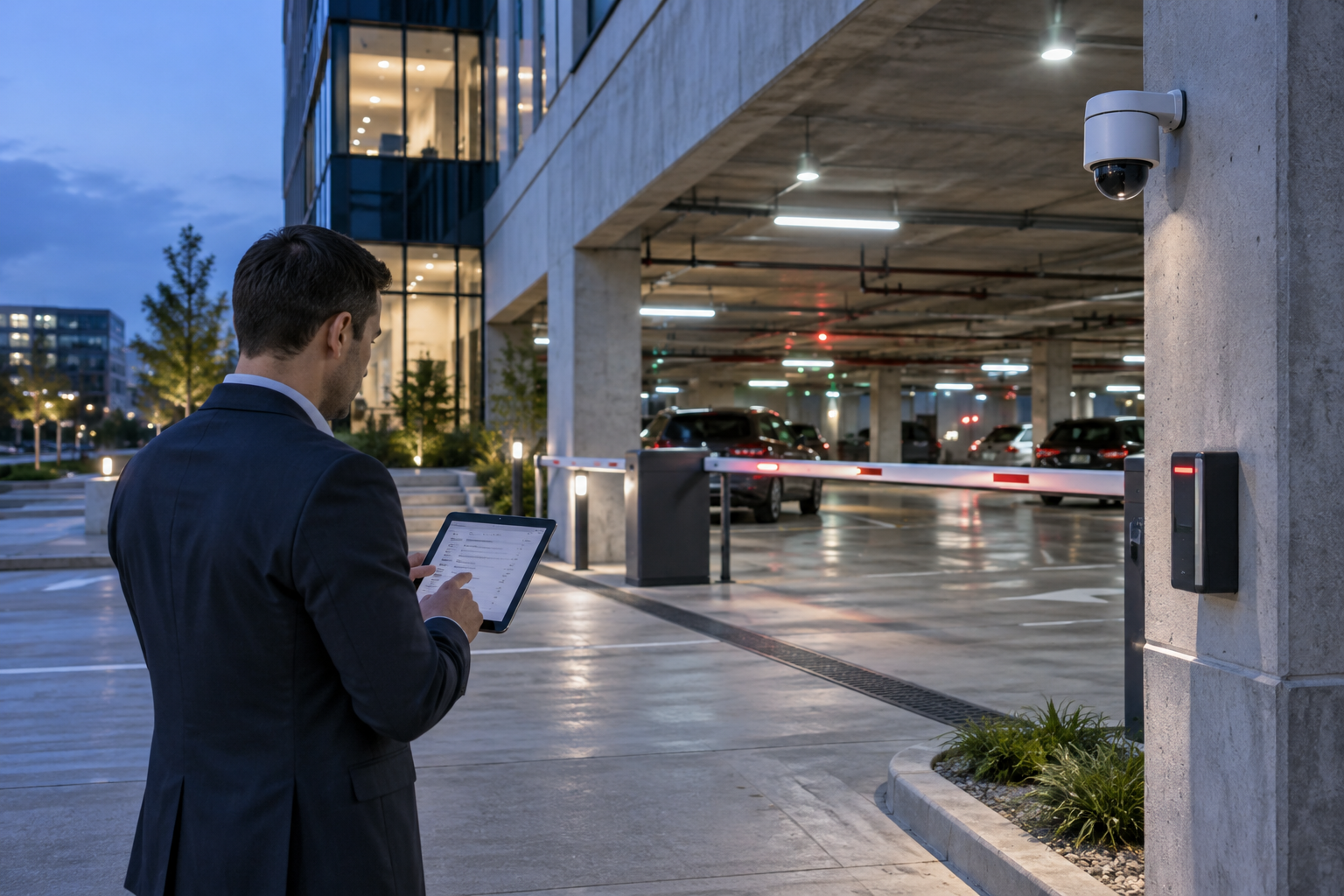
What is negligent security? Negligent security is a premises liability claim alleging that a property owner or manager failed to take reasonable steps to protect people on the property from a foreseeable crime or act of violence. A plaintiff generally has to prove four things: a duty of care, a breach of that duty, causation, and damages. For building owners, the defense is built long before an incident: assess the risk, fix known weaknesses, train the people in the building, and keep dated records that prove all three.
This guide is written for the people on the receiving end of these claims: building owners, property managers, and the attorneys and risk managers who advise them. It explains how negligent security claims work and what to put in place now.
This article is general information, not legal advice. The rules vary by state, so review your own program with counsel.
What Is Negligent Security?
Negligent security is a branch of premises liability law. The injury is caused by a third party, such as an assailant, a robber, or an active shooter, but the lawsuit targets whoever controlled the property. The theory is that the crime was foreseeable and that reasonable precautions would have prevented it or reduced the harm.
Defendants can include the building owner, the property management company, a tenant employer that controls its own space, and a security contractor. Who carries which duty usually depends on who controlled the area where the injury happened and what the lease and vendor contracts say.
Plaintiffs’ attorneys typically point to inadequate security in one or more of these forms:
- Poor or broken lighting in parking areas, stairwells, and corridors
- Broken locks, gates, or access control
- Missing or non-working cameras
- No security staffing where the risk called for it
- Staff who were never trained to respond to a threat
- No written procedures, or procedures nobody followed
- Known incidents or complaints that were never acted on
The first four are hardware and staffing. The last three are preparedness and record-keeping, and they are the hardest to prove after the fact if nothing was written down.
What a Negligent Security Lawsuit Must Prove
A negligent security lawsuit follows the ordinary negligence framework. Each element is a question the owner will have to answer with evidence, often years after the event. Foreseeability is not a separate element in most states, but it decides so many cases that it gets its own row below.
| Element | What the plaintiff argues | Records that help the owner answer |
|---|---|---|
| Duty | The owner controlled the area and owed tenants, visitors, or employees reasonable protection | Leases, management agreements, and security contracts that define who is responsible for what |
| Foreseeability | Prior incidents or warnings put the owner on notice | Dated risk assessments, incident logs, reviews of local crime, and records of threats reported to police |
| Breach | Security and preparedness fell below what was reasonable for the risk | Repair work orders, written emergency procedures, training completion records, and drill reports |
| Causation | Reasonable measures would have prevented or limited the injury | Incident timelines, notification logs, and after-action reports showing what staff did and when |
| Damages | The victim suffered physical, emotional, or financial harm | Largely outside the owner’s control, though a fast, documented response can limit the harm |
Why Foreseeability Decides So Many Negligent Security Cases
Courts do not expect owners to guarantee safety. They ask whether this kind of crime was reasonably predictable at this property. The usual evidence is prior similar incidents on or near the premises, along with complaints, threats, and police calls.
California’s leading case shows how this works. In Ann M. v. Pacific Plaza Shopping Center (1993), the California Supreme Court held that a duty to hire security guards requires a high degree of foreseeability, which can rarely be shown without prior similar incidents of violent crime on the premises. The shopping center showed that its standard practice was to record violent crime and that its records contained none before the attack. The court found no duty to provide guards.
Two lessons follow. First, a consistent incident record can protect an owner as well as expose one. Second, once incidents do appear in the record, the owner is on notice and is expected to respond. A log entry with no follow-up is the worst of both.
How entries are written matters too. Defense attorneys advise staff to record what they observed, not what they guessed. “Two vehicles idling in the north lot at 11:40 p.m.; police non-emergency line called” is a useful record. Speculation about what the occupants intended is not.
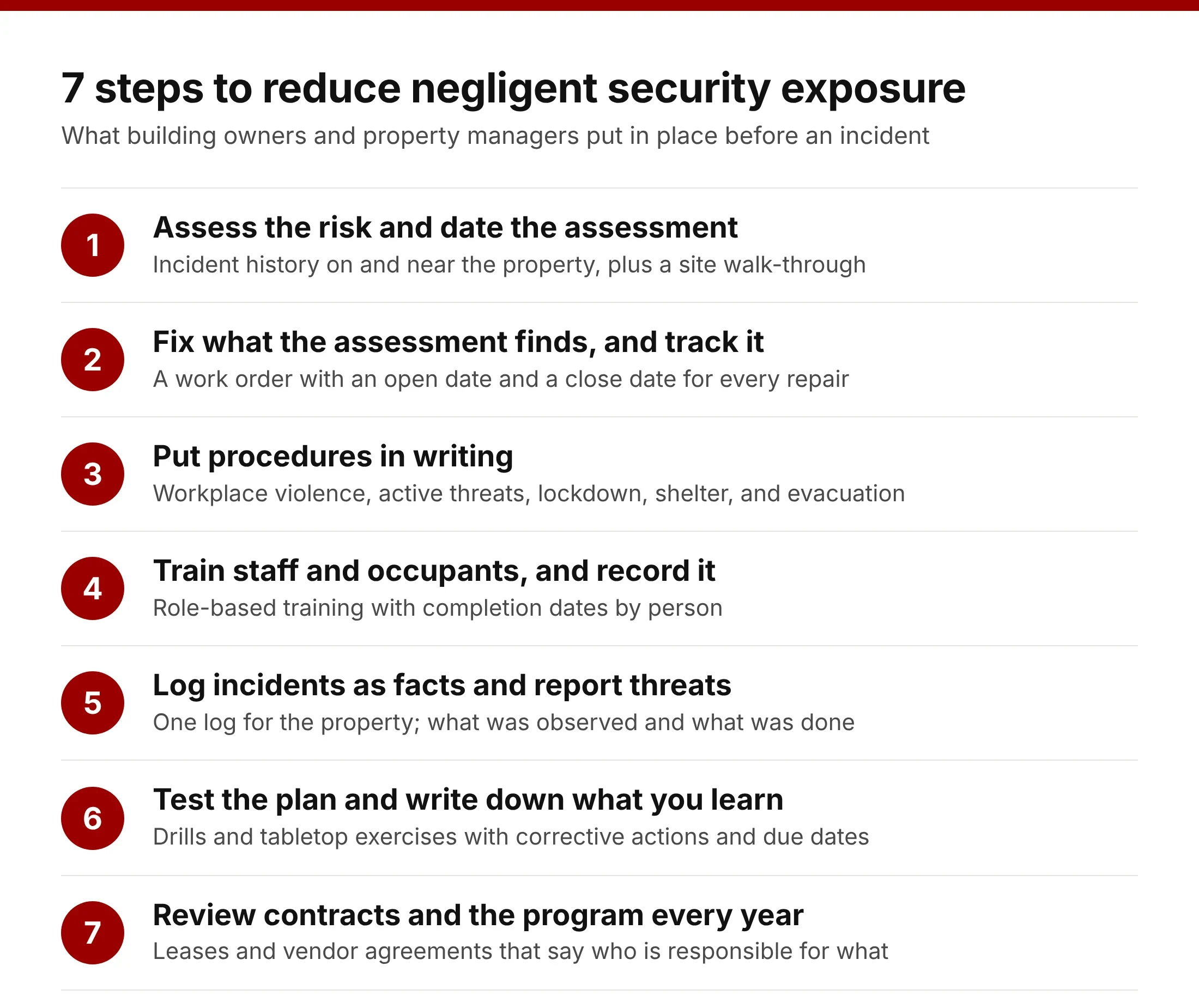
How to Reduce Negligent Security Exposure in 7 Steps
These steps apply to most commercial buildings. Adapt them to your property, your state, and your counsel’s advice.
Our guide to building safety due diligence explains how this kind of documentation holds up after an emergency.
Where Emergency Preparedness Technology Fits in a Security Negligence Defense
Building Safety Solutions does not supply guards, cameras, or locks. BSS software addresses the part of the standard of care that is hardest to reconstruct later: proof that procedures existed, that people were trained on them, and that the building could communicate when it counted.
- BSS Guardian™ is emergency preparedness software that delivers building-specific procedures and training to occupants on any device, records and reports who completed training, and can send real-time emergency notifications.
- BSS First Responder™ gives building staff and emergency personnel mobile access to interactive floor plans, building system information, and team chat, with offline access when connectivity is lost.
- BSS Archangel™ keeps policies, procedures, and equipment documentation in one secure place and trains engineering, security, and facilities staff, with management reporting on what each person has learned.
BSS has built these systems since 2001 for properties including One World Trade Center, Rockefeller Center, and LAX. If you are comparing alerting tools, start with what a mass notification system for business should cover.
Ready to document your preparedness?
Schedule a free demo to see how BSS helps you train occupants, keep the records, and answer the question every claim of this kind asks: what did you do before it happened?
Frequently Asked Questions About Negligent Security
What is negligent security?
Negligent security is a type of premises liability claim. It alleges that a property owner, manager, or other party in control of a property failed to take reasonable steps to protect people from a foreseeable crime or act of violence, and that someone was injured as a result. The person who committed the crime causes the injury, but the claim is brought against the party responsible for the property.
Is negligent security the same as premises liability?
Negligent security is one category of premises liability. Premises liability covers any injury caused by an unsafe condition on a property, such as a slip and fall. Negligent security covers injuries caused by a third party’s criminal or violent act, where the claim is that inadequate security or preparedness allowed it to happen.
What must a plaintiff prove in a negligent security lawsuit?
In most states a plaintiff must prove four elements: the defendant owed a duty of reasonable care, the defendant breached that duty, the breach caused the injury, and the plaintiff suffered damages. Foreseeability runs through all four. If the crime was not reasonably predictable at that property, courts are far less likely to find that the owner had a duty to prevent it. Some states, including Georgia, now add requirements by statute.
How do courts decide whether a crime was foreseeable?
Courts look mainly at prior similar incidents on or near the property, along with complaints, threats, and police calls the owner knew or should have known about. In California, the Supreme Court held in Ann M. v. Pacific Plaza Shopping Center that requiring security guards takes a high degree of foreseeability, which is rarely shown without prior similar violent incidents on the premises. Georgia’s 2025 law looks at substantially similar incidents on the premises or within 500 yards.
Who can be sued in negligent security claims?
Negligent security claims can name the building owner, the property management company, a tenant business that controls its own space, and a security contractor. Responsibility usually follows control: who controlled the area where the injury occurred, and what the lease, management agreement, and security contract say about each party’s duties.
What are examples of negligent security cases?
Negligent security cases commonly involve assaults in poorly lit parking lots or garages, attacks in apartment complexes with broken locks or gates, shootings at retail, hospitality, or entertainment venues, and workplace violence where warnings were ignored. One of the largest examples is the $800 million settlement approved in 2020 between MGM Resorts, its insurers, and more than 4,400 victims and relatives of the 2017 Las Vegas shooting, in which MGM acknowledged no liability.
What records should a building owner keep to defend a negligent security claim?
Keep dated risk assessments, repair work orders for lighting, locks, cameras, and access control, written emergency and workplace violence procedures, training completion records by person, drill and exercise reports with corrective actions, a factual incident log, and records of threats reported to law enforcement. Also keep the leases and security contracts that define each party’s responsibilities. The goal is to show what was known, what was done about it, and when.
Can emergency preparedness software prevent negligent security claims?
No software can stop a claim from being filed. Emergency preparedness software helps with the parts of the defense that depend on proof: that written procedures existed for foreseeable threats, that staff and occupants were trained on them, and that the building could notify people quickly. Physical measures such as lighting, locks, cameras, and security staffing still have to be addressed separately.