

What is emergency mustering? Emergency mustering is the process of gathering building occupants at a designated muster point after an evacuation and confirming that every employee, contractor and visitor is accounted for. It is the moment an evacuation becomes measurable: either everyone is out, or someone is still inside and first responders need to know where. OSHA requires a written procedure to account for all employees after an evacuation as one of six minimum elements of an emergency action plan. This guide explains how to choose and mark a muster point, the four ways buildings take a headcount, why paper rosters fail in real incidents, and how real-time digital check-ins give building managers an accurate count in seconds instead of minutes.
Why emergency mustering is the hardest part of an evacuation
Getting people out of a building is the part of an evacuation most organizations practice. Knowing who got out is the part most organizations get wrong. In a typical office building, the people in the lobby, the stairwells and the parking lot are a mix of employees from several tenants, contractors who signed in at a desk, visitors nobody logged, and staff who were off-site for lunch. A floor warden with a clipboard is trying to reconcile that against a roster printed last quarter.
The stakes are concrete. If a person is reported missing, firefighters commit crews to a search of the building. If a person is wrongly reported missing, that search happens anyway, inside a structure that may be on fire. If a person is wrongly reported safe, nobody looks for them. An audit of a 650-employee federal office found that employees were not accurately accounted for after evacuation drills because no written procedure explained how the count should be done, even though the agency’s plan required one. That gap is common, and it only becomes visible when the alarm is real.
Emergency mustering also carries legal weight. After an incident, the first questions from regulators, insurers and plaintiff’s counsel are whether the building had a plan, whether it was followed, and whether the records prove it. A time-stamped accountability record is some of the strongest evidence a building can produce; a headcount that lives in a warden’s memory is some of the weakest. The same documentation logic applies to proving building safety due diligence after an emergency.

What OSHA and NFPA require for accountability
Under OSHA’s emergency action plan standard, 29 CFR 1910.38(c), every covered employer’s written plan must include six minimum elements. Number four is “procedures to account for all employees after evacuation.” OSHA’s Evacuation Plans and Procedures eTool expands on this: designate assembly areas with enough space for everyone, take a headcount after the evacuation, assign specific employees to take it, and establish a method for accounting for non-employees such as suppliers and customers. OSHA also notes that many employers designate an evacuation warden to assist others and account for personnel.
The standard tells you that you must account for everyone. It does not tell you how, and it does not set a time limit. That is where most emergency mustering procedures are either strong or hollow. A plan that says “floor wardens will take a headcount at the assembly point” satisfies the letter of 1910.38 and fails in practice if the warden does not know who was in the building that day.
Beyond OSHA, high-rise fire codes in cities such as New York and Los Angeles require trained floor wardens and documented drills, and the drill records typically ask how long it took to account for everyone. The OSHA emergency action plan requirements and your local high-rise rules together define what your mustering procedure must deliver.
Muster point basics: choosing, marking and managing the assembly area
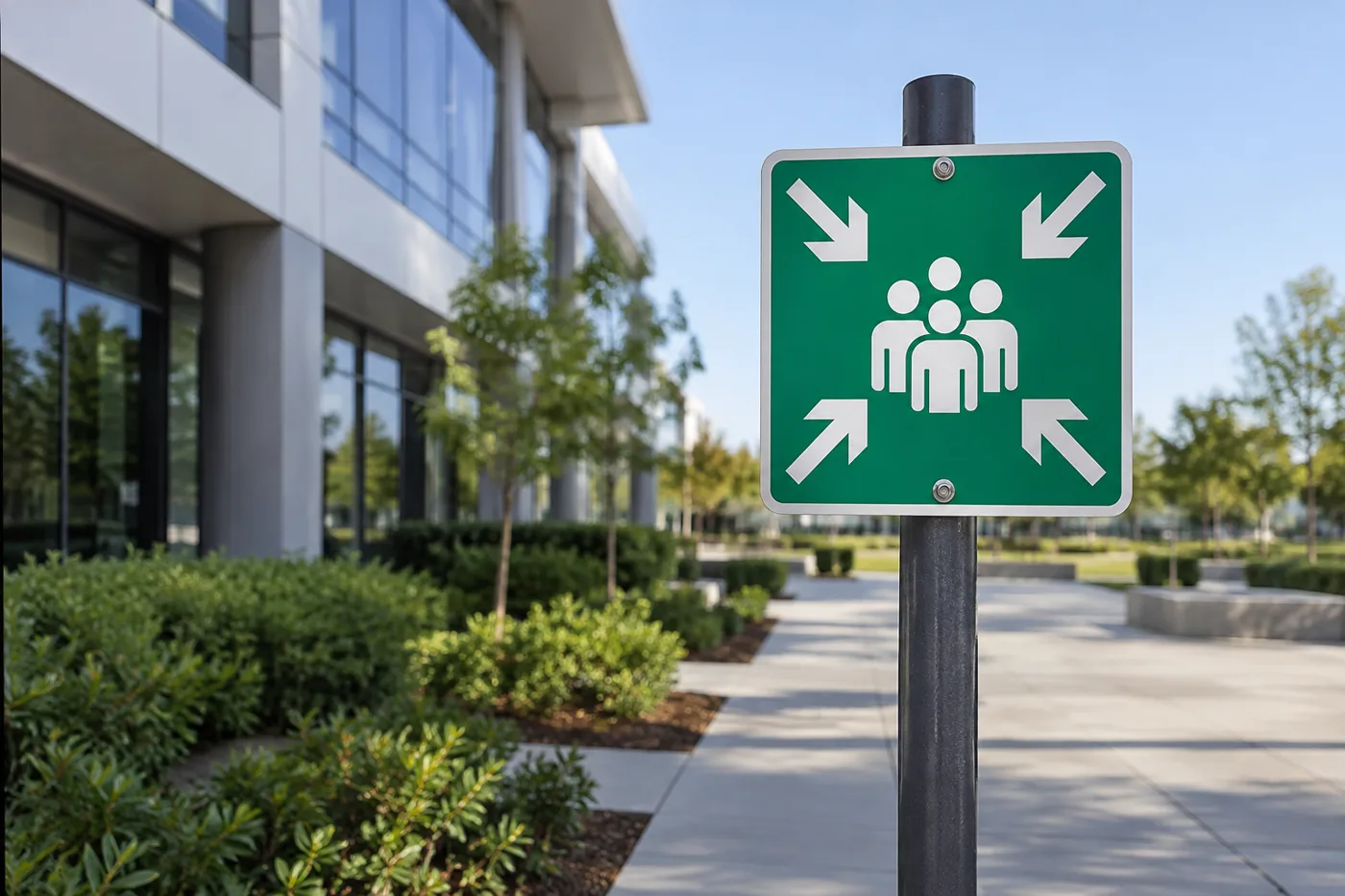
A muster point (also called an assembly point, assembly area or rally point) is the designated location where occupants gather after an evacuation so that a headcount can be taken. A good muster point meets five tests:
- Distance. Far enough from the building that occupants are clear of falling glass, smoke and apparatus staging; a common rule of thumb is at least 50 feet, and farther for large structures or hazardous-materials sites.
- Capacity. Enough space for the full occupant load of the building, including visitors, without spilling into the street.
- Access. Does not block fire lanes, hydrants, fire department connections or the route emergency vehicles will use. OSHA specifically cautions against assembly areas that interfere with rescue operations.
- Redundancy. A primary and a secondary muster point, in case wind direction, the location of the fire or police activity makes the primary unusable.
- Signage and training. Posted signs, inclusion on evacuation maps, and every occupant trained on where to go before the first drill.
Large buildings assign muster points by floor, by tenant or by stairwell so that wardens are counting a manageable group rather than the entire building population. For multi-tenant commercial real estate, this means the building’s emergency plan and each tenant’s plan have to agree on who musters where and who reports the count to building management.
Four ways buildings take a headcount, compared
Every emergency mustering procedure ends with the same question: is everyone accounted for? The method used to answer it determines how fast and how reliable the answer is.
| Method | How it works | Handles visitors and contractors | Works when wardens are absent | Time to a reliable count | Produces a defensible record | Typical failure |
|---|---|---|---|---|---|---|
| Paper roster and clipboard | Warden reads names off a printed list at the muster point | Only if a sign-in sheet was carried out | No | Many minutes; longer in large buildings | Handwritten, often not retained | Roster out of date; people at a different muster point counted as missing |
| Warden sweep and verbal report | Wardens sweep floors, then report “floor clear” by radio or in person | No | No | Depends on radio discipline | Rarely written down | Warden evacuated early or off-site; no record of who was swept |
| Badge or access-control export | Security pulls a list of badge-ins and compares it to people present | Partially (visitor badges only) | Yes | Minutes, if the report can be run during the incident | Yes, if exported and saved | Tailgating and badge-outs not recorded; needs someone at a terminal |
| Real-time mobile check-in | Occupants tap “I’m Safe” on their phone; dashboard shows who has and has not responded | Yes, if visitors are enrolled or wardens check them in | Yes | Seconds for responders; non-responders flagged immediately | Yes, automatically time-stamped | Occupants without the app or without a phone; needs enrollment discipline |
Two things stand out. First, only the two digital methods work when the warden for a floor is on vacation, in a meeting elsewhere or among the first out the door. Second, only the mobile check-in produces a list of who has not responded, which is the list firefighters actually need. A roster tells you who should be outside; a check-in dashboard tells you who is unaccounted for and which floor they were last assigned to.
How to run emergency mustering: 7 steps
- Designate and document muster points. Pick primary and secondary assembly areas for each building, floor group or tenant, confirm they meet the five tests above, and put them on every evacuation map and in the written emergency action plan.
- Assign accountability roles. Name floor wardens, alternates and a single accountability lead who receives all counts. Define what each role does if the primary person is absent. Role definitions belong in your building emergency response team roles and responsibilities document.
- Decide how you will know who was in the building. Choose a source of truth: an HR roster plus a visitor log, badge data, or a check-in platform. The method must cover employees, contractors and visitors, and it must be available outside the building during an incident.
- Set a time target. Write a target into the plan, such as a complete count reported to the incident commander within a set number of minutes of the alarm, and measure against it in every drill. Drill report forms used by fire departments commonly ask how long it took to account for everyone; if you cannot answer, the procedure is not finished.
- Train occupants, not just wardens. Every employee should know their muster point, who their warden is, and how to check in. If a mobile check-in is used, enrollment is part of onboarding, and the check-in is practiced during every fire drill procedure.
- Report unaccounted-for persons to first responders immediately. The accountability lead gives the incident commander the names, last known floors and any mobility needs of anyone unaccounted for. This hand-off should be scripted and practiced.
- Record and review. Save the count, the time it took, and the list of exceptions after every drill and every real event. Review misses, fix the cause (an outdated roster, an unenrolled contractor, a warden gap), and update the plan.
How BSS Guardian turns mustering into a live headcount
BSS Guardian is emergency preparedness software built for the problem this article describes: making sure building occupants know what to do, and giving building management a real-time, documented picture of who is safe.
- “I’m Safe” real-time check-ins. When an alert goes out, occupants confirm their status from their phone in seconds. The dashboard shows who has checked in, who has not, and which floor each non-responder was assigned to, so the accountability lead is working from a list of exceptions instead of a roster of hundreds.
- Floor-level headcount for wardens. Wardens see their own floors and their own people, report the count from the muster point, and the building-level total rolls up automatically. If a warden is absent, the floor’s check-in data is still visible to the accountability lead.
- Role-based procedures. Floor wardens, evacuation chair operators, AED responders and shelter-in-place captains each see the procedure for their role, mapped to the actual building, with interactive 2D and 3D maps showing stairwells, muster points and equipment.
- Automatic records. Every alert, check-in, drill and training completion is time-stamped and archived, producing the accountability record that OSHA inspectors, insurers and attorneys ask for after an incident, without anyone transcribing a clipboard.
- Multi-tenant and multi-building. Procedures and muster assignments are configured per location, which is why Guardian is used across commercial real estate portfolios, corporate campuses, data centers, educational institutions and law firms.
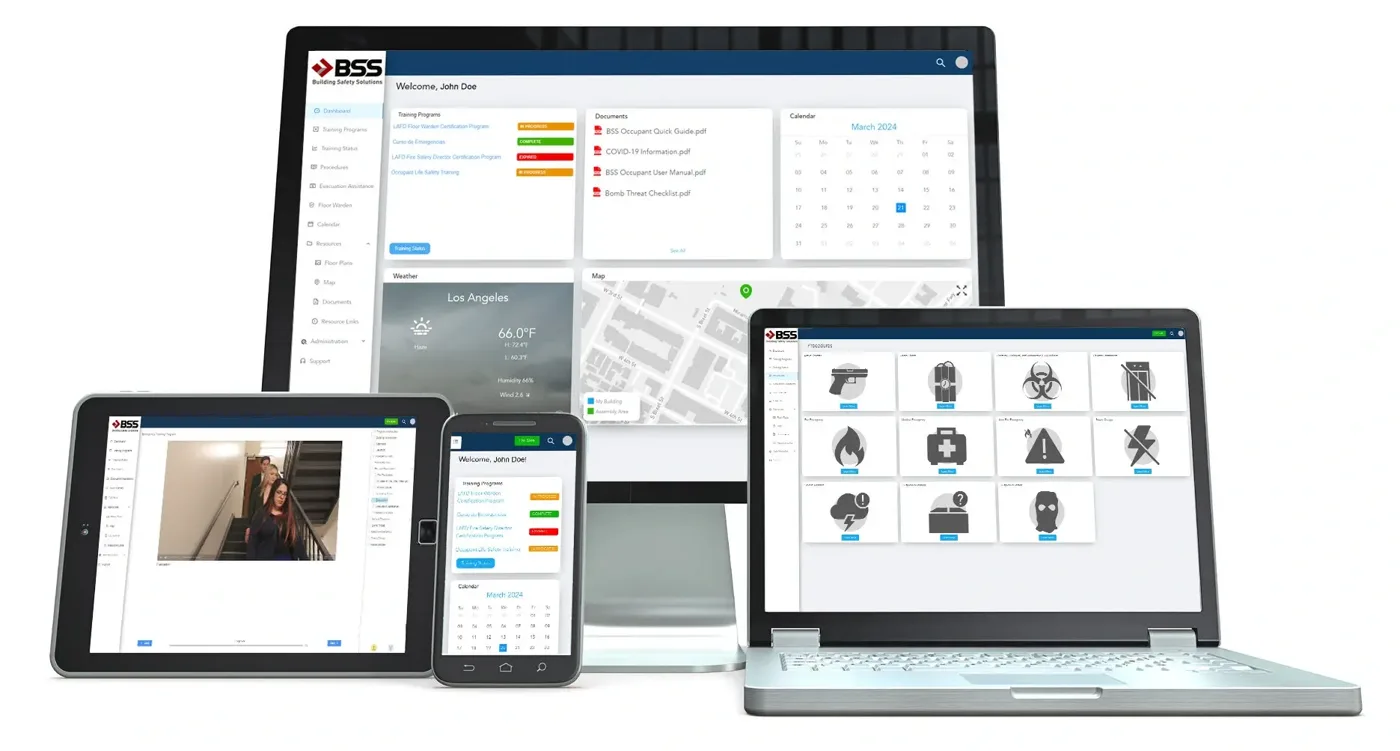
For the response team itself, BSS First Responder adds secure group chat and voice, interactive floor plans that show where critical equipment and areas of refuge are, and offline access to building information when connectivity fails, so the people coordinating the muster and the people searching for a non-responder are working from the same floor plan. Together, the two platforms replace the clipboard, the radio and the memory of whoever was last on the floor with one documented chain: alert, check-in, exception list, search, all-clear.
Common emergency mustering mistakes
- One muster point for the whole building. In a large structure this creates a crowd no warden can count and often sits in the path of arriving apparatus.
- Counting heads instead of names. A headcount that matches the expected number can still be wrong if two visitors are standing in for two missing employees. Account for people by name or by individual check-in.
- No plan for visitors and contractors. OSHA calls this out directly. If visitors are not logged and not checked in, the count is incomplete by design.
- Rosters that live inside the building. A list on a desk or a server that nobody can reach from the muster point is not a mustering tool.
- Letting people leave the muster point early. Occupants who go to their cars or to lunch before the all-clear show up as missing and trigger a search.
- Never timing the count. If a drill report does not record how long accountability took, there is no way to know whether the procedure works or to show that it does.
Frequently asked questions
What is emergency mustering?
Emergency mustering is the process of gathering all building occupants at a designated muster point after an evacuation and confirming that every employee, contractor and visitor is accounted for. Its purpose is to identify anyone who may still be inside so that first responders can be told immediately where to search. A complete mustering procedure includes designated assembly areas, assigned accountability roles, a method for knowing who was in the building, a headcount or check-in process, a hand-off of unaccounted-for persons to the incident commander, and a record of the result.
What is a muster point?
A muster point is the designated location, usually outside and a safe distance from the building, where occupants gather after an evacuation so that a headcount can be taken. It is also called an assembly point, assembly area or rally point. A good muster point is far enough away to be clear of smoke and falling debris, large enough for the full occupant load, out of the way of fire lanes and hydrants, backed up by a secondary location, and clearly marked on signage and evacuation maps.
Does OSHA require a muster point?
OSHA requires that an emergency action plan under 29 CFR 1910.38 include procedures to account for all employees after an evacuation. OSHA’s guidance says employers should designate assembly areas with enough space for all employees, take a headcount after the evacuation, assign specific employees to take it, and establish a method for accounting for non-employees such as suppliers and customers. The standard does not prescribe a specific distance or a specific counting method.
How far should a muster point be from the building?
There is no single federal distance requirement. A common rule of thumb is at least 50 feet from the building, and farther for tall buildings, facilities with hazardous materials, or sites where emergency vehicles will stage. The muster point must not block fire lanes, hydrants or fire department connections, and it should allow occupants to remain in place without being exposed to smoke, falling glass or traffic.
How long should it take to account for everyone after an evacuation?
Neither OSHA nor NFPA sets a time limit, but fire department drill report forms commonly ask how long accountability took, and many building plans set an internal target of a few minutes after the alarm. Manual roster counts in large buildings often take considerably longer. Real-time mobile check-in systems let responders confirm status in seconds and immediately produce a list of anyone who has not responded, which is the information first responders need.
How do you account for visitors and contractors during emergency mustering?
Visitors and contractors should be logged on arrival, either on a sign-in sheet that a designated person carries to the muster point or in a visitor management or check-in system that is accessible from outside the building. Hosts should be responsible for escorting their visitors to the muster point and confirming them to the warden. OSHA specifically directs employers to establish a method for accounting for non-employees.
What should a floor warden do at the muster point?
A floor warden confirms that their assigned floor was swept, gathers their assigned occupants at the muster point, takes a count by name or by check-in status, identifies anyone unaccounted for along with their last known location and any mobility needs, reports the result to the accountability lead, and keeps occupants at the muster point until the all-clear is given.
How does emergency mustering software work?
Emergency mustering software sends an alert to enrolled occupants, lets them confirm their status with a tap, and shows building management a live dashboard of who has responded and who has not, organized by floor, tenant or team. Wardens can also mark people as safe on behalf of those without a phone. Every response is time-stamped and archived, so the building has a documented accountability record for every drill and every real incident. BSS Guardian provides this capability as part of a broader emergency preparedness platform that also delivers role-based procedures, interactive maps and training records.
Make the headcount the strongest part of your plan
Emergency mustering is where an evacuation is proven. A building that can tell the incident commander, within seconds, exactly who is unaccounted for and where they were last assigned has done its job. A building still reconciling a clipboard has not. Building Safety Solutions has helped protect properties including One World Trade Center, Rockefeller Center and LAX since 2001, and BSS Guardian was built so that the accountability step is automatic, documented and defensible. Request a demo to see how a real-time “I’m Safe” check-in would work in your building.