

What is the right fire drill procedure for an office building? A sound fire drill procedure has seven parts: confirm your local code requirements, assign roles, choose a realistic scenario, sound the alarm unannounced, monitor the evacuation, account for every occupant at the assembly point, and document the results before anyone forgets them. The last step is the one most buildings skip, and it is the one that matters most after an incident. If a drill is not written down, you cannot prove it happened to an inspector, an insurer, or a jury.
This guide walks property managers, fire safety directors, and corporate safety teams through each step, explains what the fire codes and OSHA actually require, and shows exactly what belongs in a fire drill log.
Why a Written Fire Drill Procedure Matters
According to the U.S. Fire Administration, fire departments responded to an estimated 110,000 nonresidential building fires in 2023, causing 130 deaths, 1,200 injuries, and about $3.16 billion in direct losses. That is roughly 11% more nonresidential fires than the 99,500 the agency estimated for 2014. (Although more recent stats are yet to be made available. It is estimated that those numbers will only increase year over year.)
Obviously being prepared for the worst-case scenario can help you, as a building manager, prevent or at least proactively work against huge losses and damages due to fire.
A drill turns a paper plan into practiced behavior. Employees learn the nearest stairwell, floor wardens learn to sweep their areas, and the building team finds the propped-open door or the blocked exit before a real fire does. A written procedure makes each drill repeatable, so results can be compared from one drill to the next instead of depending on whoever happens to be in charge that day.
There is also a legal reason.
After an emergency, regulators, insurers, and plaintiffs’ attorneys will ask what the building did to prepare its occupants. Dated, signed drill records are among the strongest evidence you can offer. Our guide to building safety due diligence explains how that documentation holds up after an incident.
What Fire Codes and OSHA Require
Fire drill rules come from several sources, and they do not all say the same thing.
Here is how the three most common frameworks compare for office (business) occupancies.
OSHA. The federal emergency action plan standard (29 CFR 1910.38) does not set a drill schedule, but it does require procedures to account for all employees after an evacuation and trained employees to help others get out safely. Drills are how you prove both. For the full list of plan elements, see our breakdown of the OSHA emergency action plan.
International Fire Code. Most states and cities base their fire code on the IFC, often with local amendments. For business occupancies, its Table 405.2 requires annual employee drills in larger buildings, and Section 405 adds that drills should happen at unexpected times and under varying conditions, that occupants should be accounted for at the assembly point, and that no one may re-enter until authorized.
New York City. NYC sets some of the strictest rules in the country. Under FDNY Rule 3 RCNY 401-07, fire and non-fire emergency drills in office buildings must be conducted by an FDNY certificate of fitness holder and scheduled to get as many required occupants as possible to take part, and the building must keep detailed records of every drill.
| Requirement | OSHA 29 CFR 1910.38 | International Fire Code (Group B) | New York City (FC 401.7 / 3 RCNY 401-07) |
| Sets a drill frequency? | No | Yes: annually for employees in qualifying buildings | Yes: set by FC Table 401.7.6 |
| Which buildings | Employers required to have an emergency action plan | Occupant load of 500+ or more than 100 people above or below the lowest level of exit discharge | Office buildings required to have fire safety and emergency action plans |
| Who runs it | Designated, trained employees assist the evacuation | Person in charge of the building controls the drill and recall signal | FDNY certificate of fitness holder (FLS director, FEP coordinator, or drill conductor) |
| Accountability | Procedures to account for all employees required | Efforts to account for occupants at the assembly point | Floor wardens and searchers identified; participation recorded |
| Records | Written emergency action plan kept in the workplace | Nine specific items (see below) | Date, time, staff, floors, participation, scenario, lessons learned, evacuation time, weather |
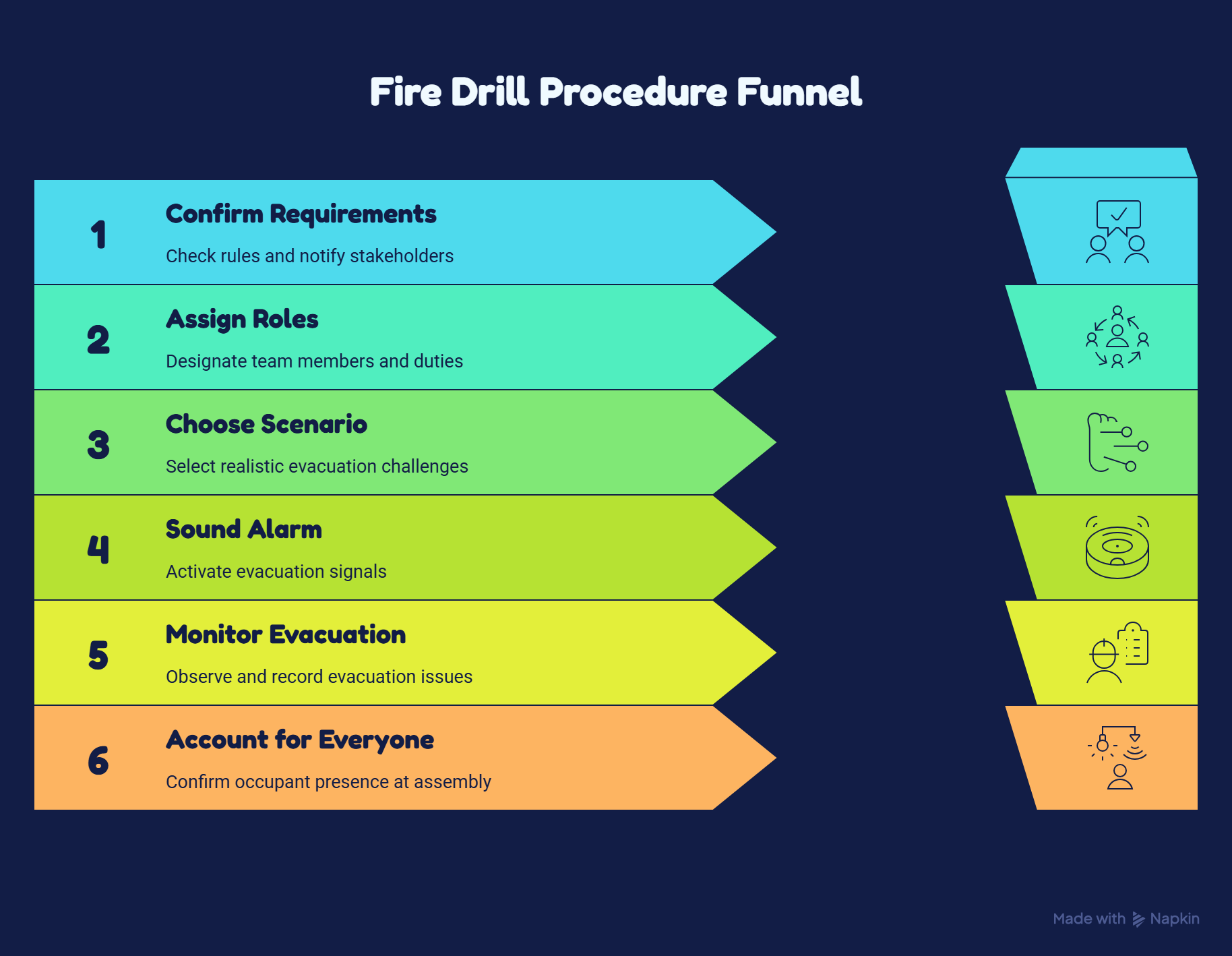
7 Steps to Conducting a Beneficial Fire Drill
Use this fire drill procedure as a template, then adapt it to your building’s emergency action plan and local code.
Step 1: Confirm requirements and notify the right people
Check the drill frequency and participation rules your jurisdiction has adopted. Then notify the fire code official (where required), your alarm monitoring company, and building security so the drill does not trigger a full fire department response. Tell tenant management that a drill is coming within a window, but not the exact time.
Step 2: Assign roles
Name a drill lead, floor wardens, searchers, stairwell monitors, and a timekeeper, plus alternates for anyone who may be out that day. Each person should know their duties before the alarm sounds. Our guide to building emergency response team roles and responsibilities covers each position in detail.
Step 3: Choose a realistic scenario
Vary the conditions from drill to drill. Simulate a blocked stairwell, a fire on a specific floor, or a missing floor warden. Changing the scenario keeps people from going on autopilot and tests whether they know a second way out.
Step 4: Sound the alarm and start the clock
Activate the alarm the same way a real emergency would be announced, including any voice communication messages. The timekeeper records the exact start time.
Step 5: Monitor the evacuation
Observers watch stairwells and exits and note problems: people using elevators, occupants stopping to gather belongings, doors that do not close, or employees who need assistance and have no assigned helper. Floor wardens and searchers sweep restrooms, conference rooms, and other enclosed spaces.
Step 6: Account for everyone at the assembly point
As occupants arrive at the assembly area, floor wardens report headcounts by floor to the drill lead. Anyone unaccounted for is treated as missing until confirmed safe. This is the step where paper lists and shouted roll calls fall apart, especially in multi-tenant high-rises.
Step 7: Recall, debrief, and document
Only the drill lead gives the recall signal to re-enter. Hold a short debrief with the response team while details are fresh, assign corrective actions with owners and due dates, and complete the fire drill log and report the same day.
What to Record in a Fire Drill Log
The International Fire Code (Section 405.5) lists nine items every drill record should include:
1. The name of the person who conducted the drill
2. The date and time of the drill
3. The notification method used
4. Staff members on duty and participating
5. The number of occupants evacuated
6. Special conditions simulated
7. Problems encountered
8. Weather conditions when occupants were evacuated
9. Time required to complete the evacuation
For stronger legal protection, also record:
• Headcount results by floor, including anyone who did not evacuate and why
• Occupants who needed assistance and how they were helped
• Corrective actions, the person responsible, and the completion date
• A signature from the drill lead or fire safety director
• Which employees had completed emergency training before the drill
Common Fire Drill Mistakes to Avoid
• Running the same drill every time. Predictable drills test memory, not readiness.
• Announcing the exact time. Occupants who know when the alarm will sound do not behave the way they would in a real fire.
• Skipping the headcount. Evacuating the building is only half the job. Accounting for everyone is the part OSHA requires procedures for.
• Letting people re-enter early. Re-entry should wait for the drill lead’s recall signal.
• Forgetting occupants with functional needs. Every person who needs help should have an assigned helper and a documented plan.
• Not writing it down. An undocumented drill offers no protection in an audit or a lawsuit.
How BSS Guardian Keeps Every Drill Documented
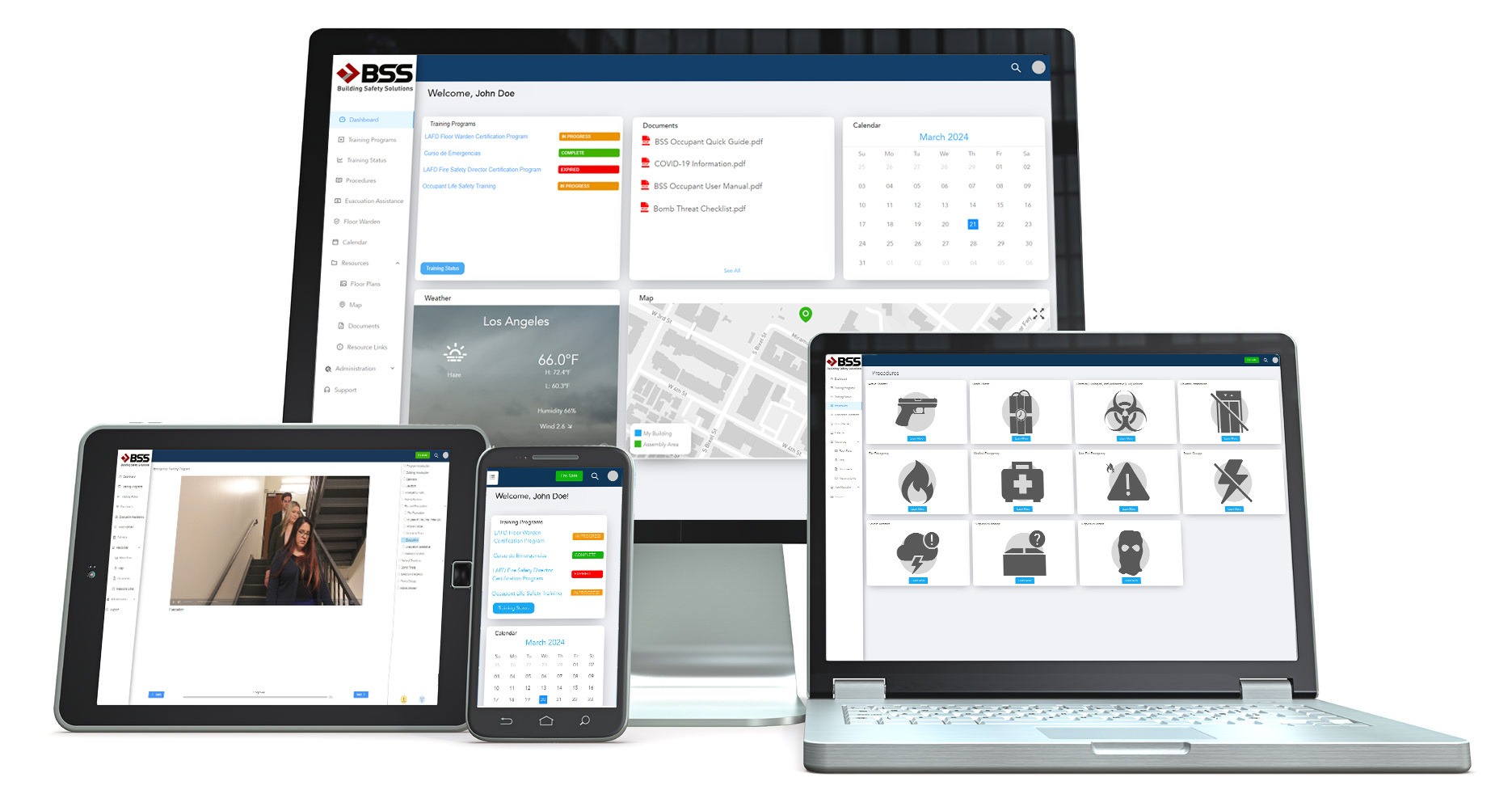
BSS Guardian™ is emergency preparedness software built for the people inside a building. It combines employee training, real-time “I’m Safe” notifications, customized response procedures, interactive 2D and 3D facility maps, and automated compliance reporting. Guardian records and archives employee training completion, drill participation, and procedure acknowledgments, so your fire drill log is built as the drill happens instead of being reconstructed afterward.
That archive is what makes audits simpler. Learn more about how emergency response software supports regulatory audits and risk assessments.
Editor note for Hector: Guardian’s upcoming Events (drill and training scheduling), Teams, and “I’m Here” floor headcount features fit this section well. Add a sentence on each once they are released.
Ready to replace the binder? Schedule a free Guardian demo to see how BSS helps your team run, track, and prove every fire drill.
Frequently Asked Questions About a Fire Drill Procedure
How often are fire drills required in office buildings?
It depends on the fire code your jurisdiction has adopted. Under the International Fire Code model language, business (Group B) occupancies must hold an emergency evacuation drill for employees at least once a year when the building has an occupant load of 500 or more people, or more than 100 people above or below the lowest level of exit discharge. Many cities and states set stricter or different rules, and New York City sets its own drill frequencies for office buildings in its Fire Code and FDNY rules. Always confirm the requirement with your local fire code official.
Does OSHA require fire drills?
OSHA’s emergency action plan standard, 29 CFR 1910.38, does not set a specific fire drill frequency. It does require a written emergency action plan when an OSHA standard calls for one, procedures to account for all employees after an evacuation, and trained employees to assist in a safe and orderly evacuation. Fire drills are the most practical way to prove those procedures and that training actually work, and local fire codes often require them independently of OSHA.
What should be recorded after a fire drill?
The International Fire Code lists nine items for drill records: the person who conducted the drill, the date and time, the notification method used, the staff on duty and participating, the number of occupants evacuated, any special conditions simulated, problems encountered, weather conditions during the evacuation, and the time required to complete the evacuation. Many building owners also record headcount results by floor, corrective actions with owners and due dates, and a sign-off from the fire safety director or drill lead.
Should fire drills be announced in advance?
Building occupants generally should not be told the exact time of a drill. The International Fire Code calls for drills to be held at unexpected times and under varying conditions so they reflect a real emergency. However, the building team should notify the fire code official where required, the alarm monitoring company, and building security ahead of time so the drill does not trigger an unnecessary fire department response.
Who should run a fire drill in an office building?
A designated drill lead should run the drill, usually the fire safety director, building engineer, or emergency preparedness coordinator. That person directs floor wardens, searchers, and stairwell monitors and controls the recall signal that lets occupants re-enter. In New York City, fire and non-fire emergency drills in office buildings must be conducted by a person holding an FDNY certificate of fitness as a fire and life safety director, fire and emergency preparedness coordinator, or drill conductor.
What is the difference between a fire drill log and a fire drill report?
A fire drill log is a running record that lists every drill a building has held, with the date, time, drill lead, participation, and evacuation time for each one. A fire drill report is a detailed write-up of a single drill that explains what happened, what went wrong, and which corrective actions were assigned. Most buildings need both: the log shows a pattern of compliance over time, and the report shows how each drill led to improvements.