

An OSHA emergency action plan is a written document required under 29 CFR 1910.38 that spells out how employees and building occupants respond to fires, natural disasters, active threats, and other workplace emergencies. Any employer with more than 10 employees must keep it in writing and train all staff on its contents. This page focuses specifically on OSHA compliance — the standard, the required elements, the penalties, and how to stay audit-ready. For a plain-English overview of what an EAP is, its workplace benefits, and a downloadable template, see our emergency action plan guide.
Failing to maintain a compliant plan exposes your organization to OSHA citations, fines up to $165,514, and significant legal liability after an incident — making this one of the most consequential compliance obligations a building manager can face.
Why OSHA Emergency Action Plans Are More Than a Checkbox
Most organizations treat their OSHA emergency action plan as a document that lives in a binder on a shelf. That’s a dangerous mistake — legally and practically.
When an emergency unfolds in a commercial building, the difference between an organized evacuation and a chaotic one often comes down to whether occupants were trained, floor wardens were designated, and real-time communication systems were in place.
According to OSHA’s emergency preparedness guidance, employers are responsible not just for writing the plan — but for implementing it, training employees on it annually, and updating it whenever personnel, facility layouts, or hazard conditions change.
For commercial building owners and property managers, this obligation runs even deeper: you are responsible for the safety of every tenant, visitor, and contractor on your property.
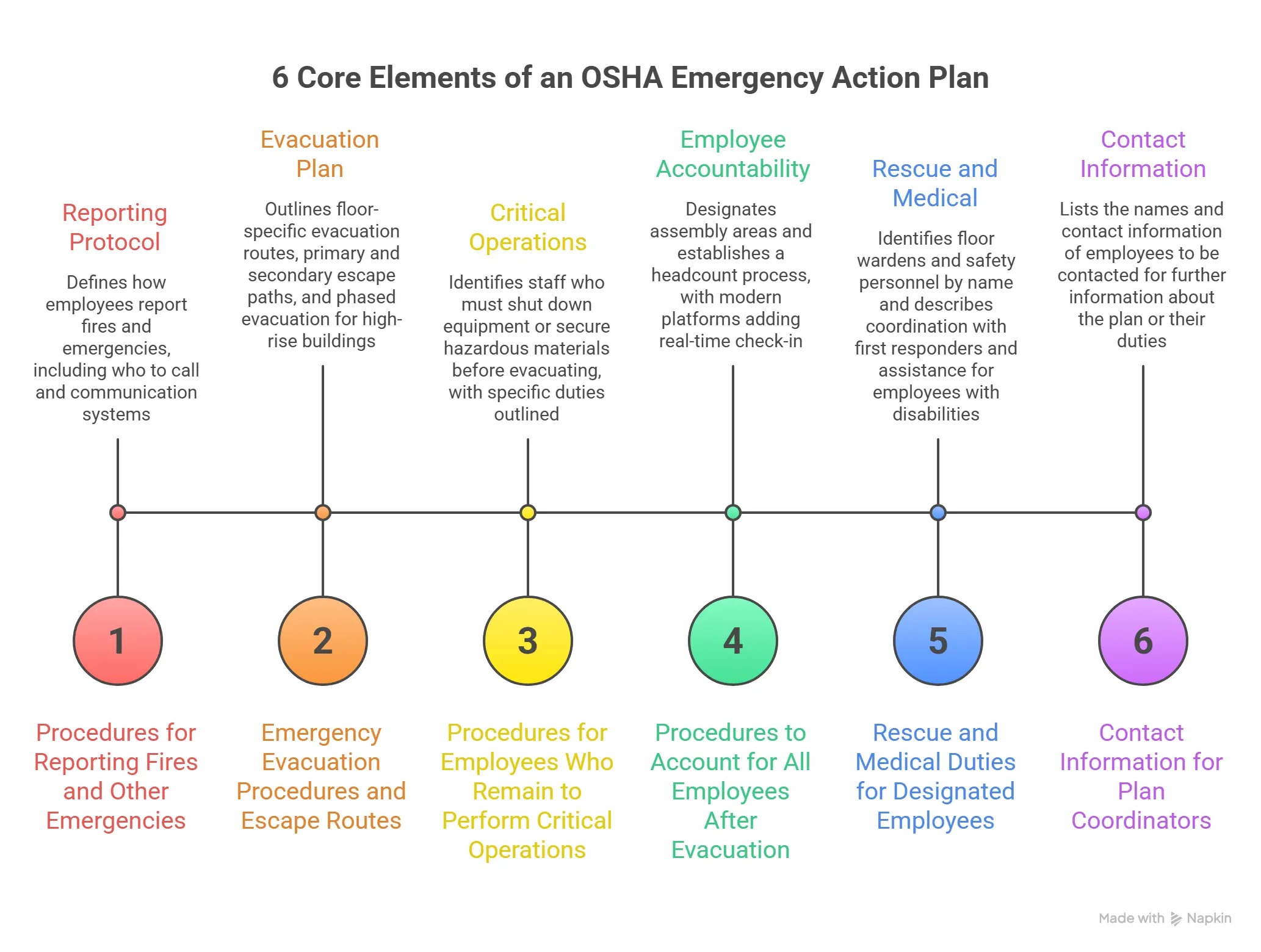
OSHA’s 6 Required EAP Elements: Compliance Checklist
OSHA’s standard at 29 CFR 1910.38 mandates that every compliant emergency action plan address the following six elements:
| # | Required element (29 CFR 1910.38(c)) | Common citation trigger |
|---|---|---|
| 1 | Procedures for reporting a fire or other emergency | No documented reporting method, or alarm system not tied to the plan |
| 2 | Evacuation procedures, types, and exit-route assignments | Missing floor-specific routes or outdated maps after a renovation |
| 3 | Procedures for employees who stay to run critical operations | Shutdown duties undefined or not assigned by name |
| 4 | Procedures to account for all employees after evacuation | No headcount/assembly process; manual counts that fail at scale |
| 5 | Rescue and medical duties for designated employees | Responders not identified by name or not trained to their duty |
| 6 | Names/titles of employees to contact about the plan | No named plan coordinator on record |
Need the full breakdown of each element plus a fill-in-the-blank starting point? Our emergency action plan template walks through all six in plain language.
OSHA EAP Requirements by Building Type
Not all buildings face identical obligations. The table below compares key EAP requirements across commercial property types most frequently cited by OSHA and local fire authorities:
| Building Type | Written EAP Required | Training Frequency | Floor Warden Required | Phased Evacuation Plan | Digital Notification Recommended | Primary Regulation |
| High-Rise Office (75 ft+) | Yes | Annual min. | Yes | Yes (floor-by-floor) | Strongly recommended | OSHA + Local Fire Code |
| Commercial Office (<75 ft) | Yes | Annual min. | Recommended | No | Recommended | OSHA 1910.38 |
| Data Center | Yes | Annual min. | Yes | Yes | Critical | OSHA + Industry Regs |
| Corporate Campus | Yes | Annual min. | Yes (per building) | Varies | Strongly recommended | OSHA 1910.38 |
| Educational Institution | Yes | Semester drills | Yes | Yes | Required (most states) | OSHA + State Regs |
| Warehouse / Industrial | Yes | Annual min. | Recommended | No | Recommended | OSHA 1910.38 |
Key Stat: As of the January 2026 inflation adjustment, OSHA can fine employers up to $16,550 per serious violation and up to $165,514 for willful or repeated violations of emergency action plan requirements. A documentation gap discovered after an incident is typically cited as a serious violation.
How to Build an OSHA-Compliant EAP That Passes an Audit
The pillar guide covers how to build an EAP from scratch. The steps below focus on the compliance layer — the documentation, coordinator accountability, and recordkeeping OSHA actually inspects.
1. Conduct a Hazard Assessment — Walk every floor and identify all potential emergency scenarios — fire, gas leak, power failure, active threat, medical emergency, earthquake, flooding. Each hazard type may require a different response protocol.
2. Designate an EAP Coordinator — Assign a named individual (not just a role title) as the EAP coordinator. This person owns plan maintenance, training schedules, and is the primary OSHA compliance contact.
3. Map and Document All Evacuation Routes — Create floor-specific evacuation maps identifying primary and secondary exits, stairwell locations, areas of rescue assistance, and outdoor assembly points. Post physical copies on every floor.
4. Designate and Train Floor Wardens — Identify at least one floor warden per occupied floor. Train them on evacuation procedures, headcount protocols, first responder communication, and special-needs assistance. Document all training completion.
5. Establish an Alarm and Notification System — Define how occupants will be alerted to each emergency type. A real-time emergency management software platform can automate and document this process across multi-tenant buildings.
6. Define Critical Operations Shutdown Procedures — For HVAC, server rooms, chemical storage, and medical gases — document the exact shutdown procedure and assign responsibility by name.
7. Create an Employee Accounting System — Establish how you will account for every employee post-evacuation. Digital “I’m Safe” check-in systems are far more reliable than paper-based headcounts in multi-tenant high-rises.
8. Integrate First Responder Information — Ensure arriving fire, EMS, and law enforcement have immediate access to floor plans, utility shutoffs, hazardous materials locations, and emergency contacts before they enter the building.
9. Conduct Annual Training and Drills — OSHA requires training when the plan is first developed, when employees are initially assigned, and whenever the plan is updated. For drills, follow a written fire drill procedure so every exercise is run and documented the same way.
10. Review and Update the Plan Annually — Any change in staffing, floor layout, contacts, or hazard conditions triggers a required update. Treat this as a compliance obligation, not an optional task.

The Most Common OSHA Emergency Action Plan Failures
Even organizations with a written EAP frequently fail in execution. The gaps most likely to create liability after an incident:
Outdated Floor Plans
Buildings change constantly. A static PDF plan becomes inaccurate within months. Digital platforms with live, updated floor plans eliminate this risk.
Incomplete Training Documentation
OSHA inspectors and plaintiff attorneys both ask for the same thing after an incident: proof of training. If you can’t produce sign-in sheets and completion records, a compliant-looking plan offers no legal protection. Emergency response software automates this documentation in real time.
No Employee Accountability System
Manual headcounts fail in large buildings. Digital check-in reporting solves this at scale — and creates the audit trail your legal team will need.
Plans That Don’t Address All Hazard Types
Many EAPs cover fire evacuation and nothing else. In California, plans must include earthquakes and, under California Senate Bill 553, active threat and workplace violence scenarios.
First Responders Arrive Without Critical Building Data
When firefighters or EMS enter without knowing where gas shutoffs, server rooms, or hazardous materials are located, response time suffers and damage escalates. Platforms like BSS First Responder™ give first responders this information on mobile devices before they enter the building.
How Technology Transforms OSHA EAP Compliance
Maintaining a fully compliant OSHA emergency action plan across a multi-floor, multi-tenant commercial property is not a task that paper and PDFs can reliably support. BSS Guardian™ was built specifically to digitize and operationalize the OSHA emergency action plan for commercial buildings. It provides:
• Customized emergency procedures for every building type and incident scenario
• Real-time notifications to all occupants across any device, 24/7
• Training completion tracking and compliance documentation for OSHA audits
• “I’m Safe” check-in reporting for post-evacuation accountability
• Full audit-trail documentation for regulatory inspections and legal defense
For building managers preparing for an OSHA audit, this level of building safety due diligence is what separates organizations that survive scrutiny from those that don’t.
Ready to Build a Compliant OSHA Emergency Action Plan?
Building Safety Solutions has protected iconic properties including One World Trade Center, Rockefeller Center, and the Burj Khalifa with technology-driven emergency preparedness systems for more than 20 years.
Request a free demo to see how BSS Guardian™ can digitize and strengthen your OSHA EAP compliance.
Frequently Asked Questions: OSHA EAP
What OSHA standard requires an emergency action plan?
OSHA’s emergency action plan requirements are set out in 29 CFR 1910.38. The standard applies whenever another OSHA rule requires an EAP, and it defines the six minimum elements every plan must contain. Employers with more than 10 employees must keep the plan in writing and available for review; those with 10 or fewer may communicate it orally.
What are the OSHA penalties for not having an emergency action plan?
As of the January 2026 adjustment, OSHA can assess up to $16,550 per serious or other-than-serious violation and up to $165,514 per willful or repeated violation, plus up to $16,550 per day for failure to abate. Missing or undocumented EAP elements are typically cited as serious violations, and penalties escalate for repeat offenders or incidents involving injury.
Does OSHA require a written EAP for businesses with fewer than 10 employees?
No. Under 29 CFR 1910.38(b), an employer with 10 or fewer employees may communicate the plan orally rather than keeping it in writing. The plan must still cover the same required content — only the written-documentation requirement is relaxed. Every employer with more than 10 employees must maintain the EAP in writing and keep it accessible to staff.
What do OSHA inspectors look for in an emergency action plan audit?
Inspectors verify that a written plan exists and is accessible, that it addresses all six required elements, and — most often the weak point — that training is documented. After an incident, OSHA and plaintiff attorneys both ask for proof of training: sign-in sheets, completion dates, and evidence the plan was reviewed when employees were assigned, when duties changed, and when the plan was updated.
What is the difference between an OSHA EAP and a fire prevention plan?
An emergency action plan (1910.38) covers all emergency scenarios and focuses on how employees respond during an emergency. A fire prevention plan (1910.39) focuses on preventing fires from starting. Both may be required, and they can be combined into a single document if all elements of each are addressed.
Do state OSHA plans have stricter EAP requirements?
They can. States that run their own OSHA-approved programs must be at least as effective as federal OSHA and may impose stricter rules or higher penalties. California, for example, layers Senate Bill 553’s workplace violence prevention requirements on top of the federal EAP standard. Confirm the rules of the State Plan covering each worksite.
Does an OSHA emergency action plan need to include active shooter procedures?
OSHA’s general standard requires addressing all foreseeable emergencies, which is broadly interpreted to include active threat scenarios. In California, Senate Bill 553 (effective July 1, 2024) explicitly requires a written Workplace Violence Prevention Plan that includes active threat procedures.