

When an emergency unfolds inside a commercial or a residential building — a fire, an active threat, a gas leak, a medical crisis — the difference between a coordinated response and a dangerous one often comes down to a single question: how fast did the right people get the right information?
A mass notification system for business is the infrastructure that answers that question.
It’s not a backup phone tree or a floor warden with a bullhorn. It’s a purpose-built platform that delivers verified, actionable alerts across every available channel simultaneously — to hundreds or thousands of occupants, in seconds, regardless of where they are in the building or what device they have in hand.
This guide breaks down how these systems work, what features actually matter, and what property managers and facilities directors should know before selecting one.
What Is a Mass Notification System for Business?
A Mass Notification System (MNS) is a communication platform designed to deliver time-sensitive alerts to a large group of people during a crisis or critical event. In a business context, this typically means employees, contractors, tenants, and building occupants across one or more locations.
Modern systems go well beyond simple broadcast messaging. They’re integrated platforms that can:
- Deliver alerts simultaneously via SMS, email, push notification, voice call, digital signage, desktop pop-up, and PA system
- Target specific floors, zones, or occupant groups rather than broadcasting to everyone
- Enable two-way communication, allowing recipients to acknowledge alerts or report their status
- Log all notification activity in real time for post-incident review and compliance documentation
The term is sometimes used interchangeably with “emergency notification system,” though the two are slightly different in scope.
Mass notification systems typically emphasize large-scale, multi-channel outreach to a broad audience, while emergency notification systems may focus more narrowly on incident-specific alerting within a defined environment. In practice, most enterprise-grade platforms serve both functions.
Why Businesses Can’t Rely on Phone Trees and Email Alone
Phone trees were standard practice in workplace emergency planning for decades. They’re also one of the least reliable methods available when time is critical.
The problems are structural. A phone tree depends on every person in the chain reaching the next. If one contact doesn’t answer — whether they’re in a meeting, away from their desk, or simply don’t pick up — the chain breaks. By the time a message reaches the last person on the list, the window for taking protective action may have already closed.
Email has its own limitations in a crisis. Open rates drop significantly when people are moving, distracted, or actively evacuating. Push notifications often go unread during peak activity hours.
Even PA systems — still the most universal broadcast tool in most buildings — offer no confirmation that occupants have received, understood, or acted on the message.
The Federal Emergency Management Agency (FEMA) recommends that emergency communications reach people through multiple simultaneous channels to account for the variability in how individuals receive and process alerts. This multi-channel redundancy isn’t a feature preference — it’s foundational to effective emergency communication design.
What makes a dedicated mass notification system different is the combination of speed, reach, and verifiability. Alerts can be triggered in seconds, delivered across every available channel at once, and tracked to confirm delivery at the individual level.

Core Features to Look for in a Business Mass Notification System
Not all platforms are built the same. The feature set that matters for a single corporate campus looks different from what a multi-tenant high-rise or a university campus requires. That said, certain capabilities are non-negotiable for any business environment.
Multi-Channel Delivery
The platform should be able to reach people simultaneously through at least five communication channels: SMS text, email, voice call, mobile push notification, and on-screen desktop alert.
Systems that also integrate with building PA infrastructure, digital signage, and emergency strobe or LED systems offer meaningfully better coverage, particularly for environments where some occupants may not have phones on them.
Two-Way Communication
One-way broadcasts tell people what to do. Two-way communication tells you whether they received the message and how many are accounted for. During an active evacuation or a shelter-in-place scenario, the ability to receive status confirmations from occupants dramatically improves the accuracy of incident command decision-making.
Geo-Targeting and Zone-Based Messaging
A building-wide alert is appropriate for some emergencies. For others — a localized gas leak on the third floor, a medical event in the lobby — blanket messaging creates unnecessary panic and impedes response.
Systems with floor- or zone-based targeting capability allow emergency managers to send tailored messages to exactly the right group of people without disrupting everyone else.
Compliance Documentation and Audit Trails
This is often undervalued until there’s a legal question. A robust mass notification platform logs every alert sent, every delivery confirmation received, and every acknowledgment returned. That record becomes critical documentation in the event of a regulatory audit, an OSHA investigation, or litigation following an incident.
OSHA’s Emergency Action Plan requirements create an implicit expectation that employers can demonstrate not just that they had a communication plan, but that it was executed correctly.
Ease of Activation
The most capable system in the world is useless if the person who needs to trigger it can’t find it under pressure. Platforms should offer simple, one-touch activation for predefined scenarios — fire, lockdown, medical, weather, active threat — without requiring the operator to compose a message from scratch. Templates, pre-approved messaging, and intuitive interfaces are prerequisites, not optional upgrades.
What Types of Emergencies Should a Mass Notification System Cover?
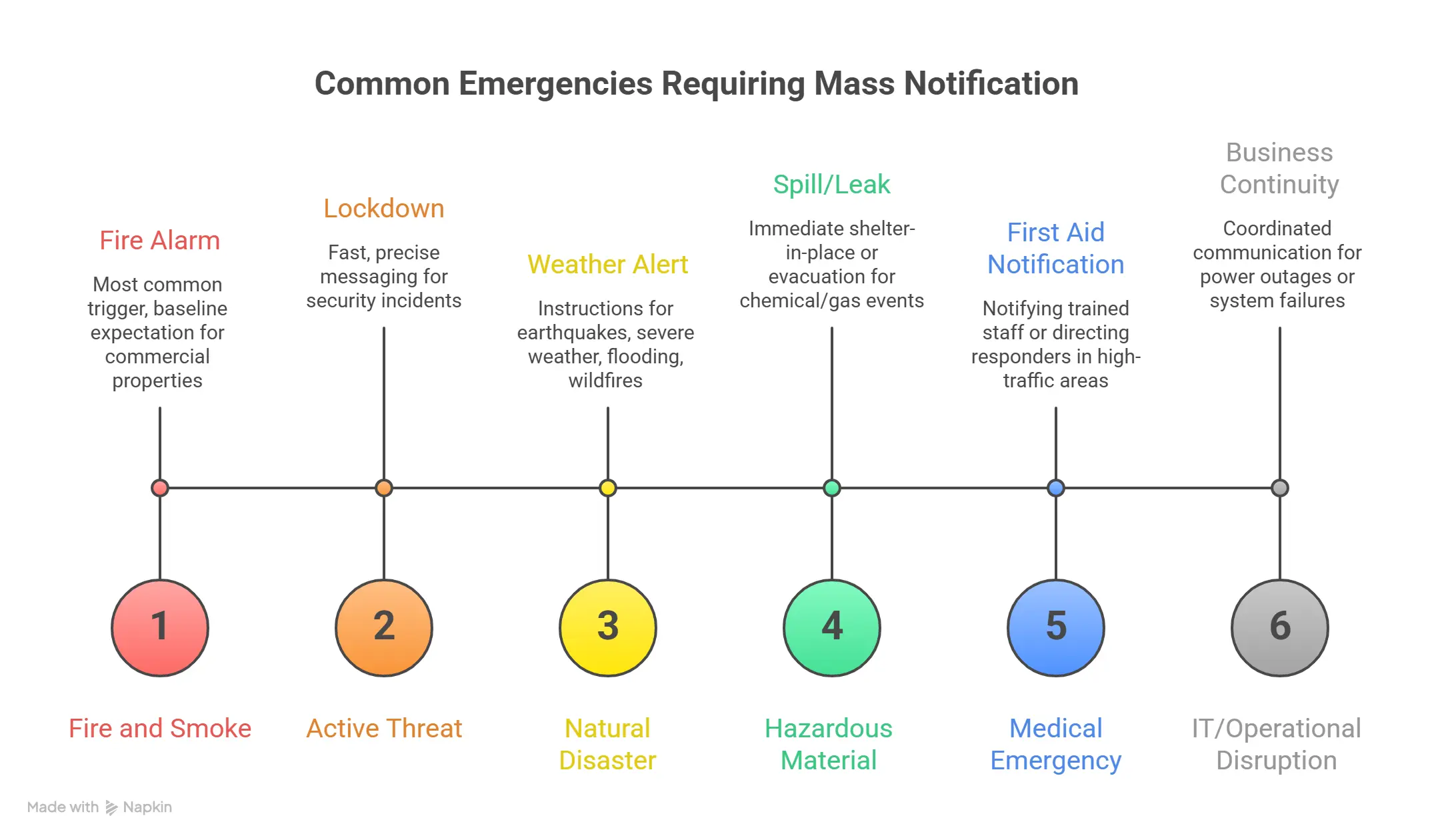
A common mistake in procurement is narrowly scoping the system to a single use case — usually fire — and building around that. In practice, the emergencies that require mass notification are much broader:
- Fire and smoke — the most common trigger and the baseline expectation for any commercial property
- Active threat or security incident — lockdown procedures require fast, precise messaging that varies by occupant role and location
- Natural disasters — earthquakes, severe weather, flooding, and wildfires each require different protective actions and different occupant instructions
- Hazardous material events — chemical spills, gas leaks, or airborne contamination require immediate shelter-in-place or evacuation depending on the scenario
- Medical emergencies — in high-traffic facilities, notifying trained first aid staff or directing emergency responders to the right location can be lifesaving
- IT or operational disruptions — business continuity events like power outages or system failures may not threaten physical safety, but they still require coordinated communication
Systems that support custom scenario templates for each of these event types — with distinct messaging, different recipient groups, and appropriate escalation protocols — provide far more value than general-purpose broadcast tools.
Thinking through these scenarios is also a core component of business continuity planning, which looks at how organizations maintain operations — and protect people — across a range of disruptive events.
Mass Notification and Legal Liability: What Employers Need to Know
Workplace emergency communication sits at the intersection of operational safety and legal compliance. Several regulatory frameworks create direct or indirect obligations around how businesses communicate during emergencies.
OSHA’s Emergency Action Plan standard (29 CFR 1910.38) requires employers to establish and communicate procedures for emergencies including fire and severe weather.
While the standard predates modern mass notification technology, its intent — ensuring employees receive timely, accurate instructions during emergencies — is best served by systems that can demonstrate delivery at scale.
California’s Senate Bill 553, which took effect in July 2024, adds specific documentation requirements around workplace violence prevention, including emergency response procedures that employees must be able to access.
The compliance and audit trail features of a mass notification system directly support this kind of documented preparedness requirement.
Beyond regulatory compliance, the liability exposure from a poorly communicated emergency can be substantial. If an employer is unable to demonstrate that occupants received appropriate warnings and instructions in a timely manner, that gap can become a focal point in negligence claims.
The International CISA guidance on emergency communications notes that documentation of notification activities is a core component of defensible emergency management practice.
The inverse is also true: organizations with well-documented, demonstrably effective communication systems are in a significantly stronger position to demonstrate due diligence if an incident does result in harm.
How to Evaluate and Implement a Mass Notification System
The evaluation process for a mass notification platform should be structured around the specific characteristics of your environment — building size, occupant mix, existing infrastructure, and the types of emergencies your location is most likely to face.
A practical starting framework:
1. Inventory your current communication infrastructure. What systems are already in place — PA, fire alarm integration, existing communication apps? Understanding the baseline helps identify gaps rather than redundancies.
2. Define your notification scenarios. For each emergency type your facility might face, map out who needs to know, what they need to know, and how quickly. This scenario mapping becomes the blueprint for system configuration.
3. Evaluate integration requirements. A mass notification system should work with your existing fire alarm panels, access control systems, and building management infrastructure. Standalone systems that require manual triggering in every scenario are a significant operational vulnerability.
4. Assess delivery verification capabilities. Ask vendors specifically how they report on message delivery — not just send confirmation, but actual read receipts, acknowledgments, and undelivered message alerts.
5. Plan for drill and training cadence. System effectiveness degrades without practice. Establish a regular schedule for testing scenarios, verifying contact list accuracy, and training staff on activation procedures.
Building occupant preparedness — making sure people know how to receive and respond to notifications — is equally important on the receiving end. This is where the operational value of emergency management software extends beyond the notification event itself, equipping occupants in advance with the procedures and protocols they’ll need to act on an alert when it arrives.
Mass Notification Systems FAQs
What is the difference between a mass notification system and an emergency alert system?
The terms are often used interchangeably, but there’s a functional distinction. Emergency alert systems typically refer to government-operated public warning platforms like FEMA’s Integrated Public Alert and Warning System (IPAWS). Mass notification systems for business are privately operated platforms that organizations use to communicate with their own employees, tenants, and building occupants. Both serve critical roles, but they operate independently of each other.
How many communication channels does a business mass notification system need?
Best practice guidance generally recommends a minimum of four to five simultaneous channels — SMS, email, voice, push notification, and at least one physical in-building system (PA, digital signage, or desktop alert). Each channel reaches a different subset of your audience, and redundancy is what makes communication reliable during high-stress events when any single channel may be missed.
Can a mass notification system be used for non-emergency business communications?
Yes, most enterprise platforms support routine communications like operational alerts, policy updates, and scheduled announcements. However, the risk of overuse is real — if occupants begin associating the system with routine messaging, they may not respond with appropriate urgency during an actual emergency. Many organizations keep mass notification channels reserved for genuine emergencies and use separate tools for routine communication.
What is the typical implementation timeline for a business mass notification system?
Implementation timelines vary significantly based on building complexity, integration requirements, and the size of the occupant population. Simple single-location deployments can be configured and tested in days. Large, multi-building or multi-tenant environments with deep building infrastructure integration typically require weeks to months to fully implement, test, and train on. Factor training time into any implementation timeline estimate.
Who should have authorization to trigger emergency notifications?
This depends on the organization and facility type, but the answer should always be documented in a formal authorization policy. Most environments designate a primary activator (often the building emergency director or security manager), one or more backup activators, and in some configurations, authorized automated triggers tied to fire panels or intrusion detection systems. Clarity on authorization prevents both unauthorized activations and, more commonly, hesitation during an actual emergency.
Choosing the Right System for Your Environment
A mass notification system for business is not a commodity purchase. The right platform for a single-tenant corporate campus, a multi-tenant Class A office tower, or a data center with mission-critical operations will look different in each case — different integrations, different notification scenarios, different compliance requirements.
What those environments share is the same fundamental need: when something goes wrong, the right people need verifiable, actionable information fast. The evaluation and selection process should be driven by that operational requirement first, and feature lists second.
For organizations managing commercial real estate, corporate campuses, or public sector facilities, building an emergency preparedness and incident response system that integrates mass notification capabilities with occupant procedures and first responder coordination provides a more complete picture of preparedness than a standalone alert platform alone.
Building Safety Solutions (BSS) develops technology platforms that help organizations prepare for, respond to, and recover from emergencies. BSS serves commercial real estate, corporate, government, and educational clients in facilities across North America and internationally.