
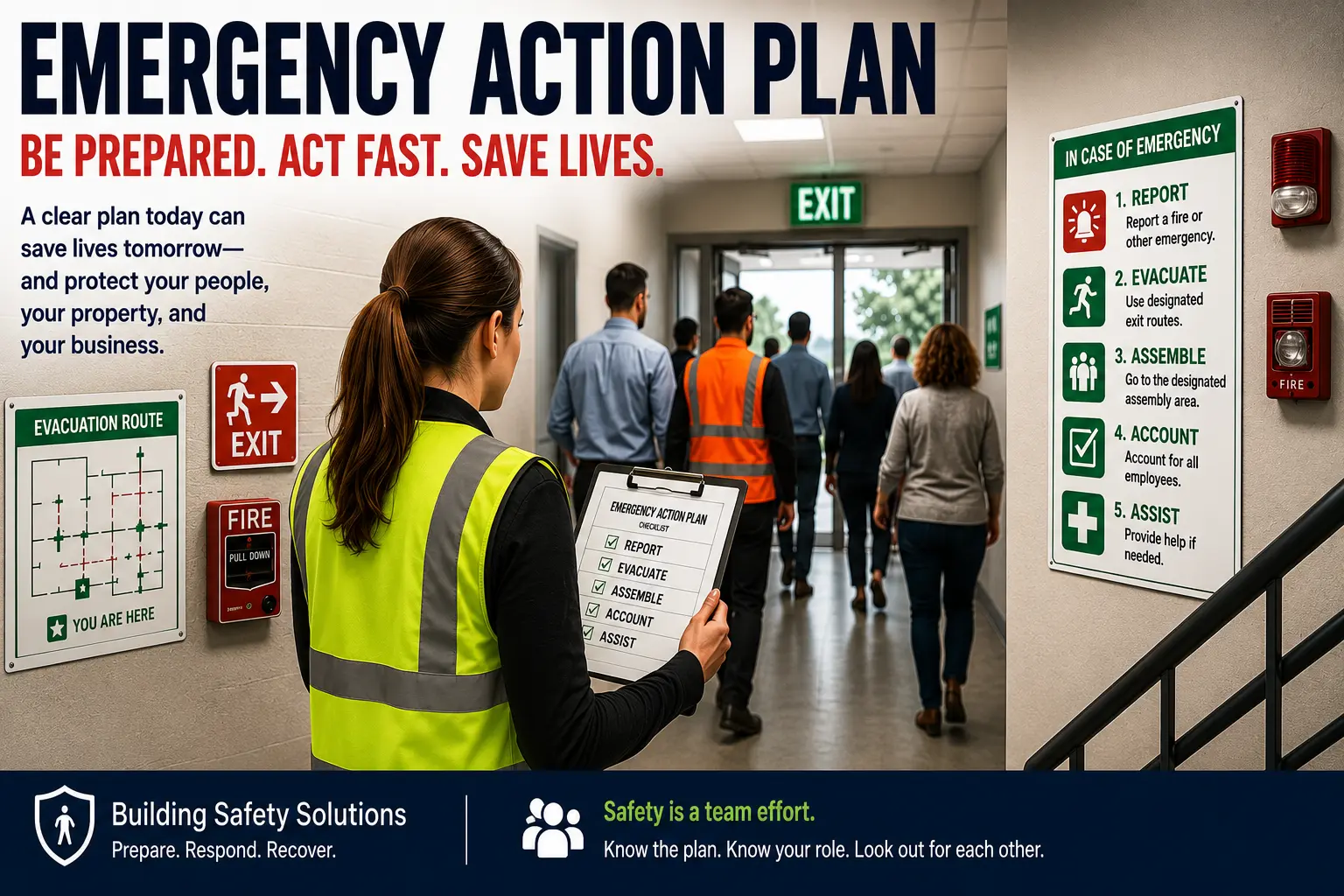
An emergency action plan (EAP) is a written document that tells employees exactly what to do before, during, and immediately after a workplace emergency—such as a fire, severe-weather event, medical crisis, chemical release, or act of workplace violence. Under OSHA standard 1910.38, a compliant emergency action plan must cover at least six required elements, from evacuation routes to how staff are accounted for once they are outside. A well-built EAP does three things at once: it protects lives, limits legal liability, and keeps your business running when every second counts.
Quick facts: OSHA requires a minimum of 6 EAP elements • Employers with more than 10 employees must keep the plan in writing • Ready.gov outlines a 10-step process for building one.
What Is an Emergency Action Plan?
An emergency action plan is the first layer of workplace safety: a clear, written set of procedures that removes guesswork in the moments when hesitation costs the most. It answers the practical questions employees will have under pressure—how do I report an emergency, which way do I exit, where do we gather, and who is in charge? OSHA’s Evacuation Plans and Procedures eTool frames the EAP as the foundation businesses use to comply with federal emergency standards.
It helps to know what an EAP is not. An EAP governs the immediate, life-safety response. Recovering operations afterward—restoring systems, facilities, and revenue—is the job of a separate business continuity plan. The two work together, but they are distinct documents with different goals and different owners.

What Must an Emergency Action Plan Include?
According to OSHA’s emergency action plan standard (29 CFR 1910.38), an emergency action plan must include, at a minimum, the six elements below. Employers with 10 or fewer employees may communicate the plan orally; everyone else must keep it in writing and available for employees to review.
| Required element (OSHA 1910.38) | What it covers |
| 1. Emergency reporting procedures | How employees report a fire or other emergency—alarms, phone numbers, or notification apps. |
| 2. Evacuation procedures & exit routes | The type of evacuation and specific exit-route assignments for each area of the building. |
| 3. Critical-operations shutdown | Procedures for employees who stay behind to operate essential equipment before they evacuate. |
| 4. Employee accountability | How the organization accounts for all employees once evacuation is complete. |
| 5. Rescue and medical duties | Procedures for employees assigned to perform rescue or medical tasks. |
| 6. Points of contact | The name or job title of employees who can explain the plan or an employee’s duties under it. |
Beyond these minimums, OSHA emergency action plan requirements include a maintained employee alarm system and designated, trained employees to help others evacuate safely.
How Does an Emergency Action Plan Benefit Your Workplace?
An emergency action plan benefits your workplace by turning panic into a practiced routine. A clear, well-rehearsed EAP delivers five measurable advantages:
• Faster, safer evacuations — employees know their exit route and muster point without waiting for instructions.
• Fewer injuries and fatalities — the actions taken in the first minutes of an emergency are the ones that save lives.
• Reduced legal and financial liability — documented procedures and training demonstrate due diligence and support OSHA compliance.
• Protected business continuity — a controlled response limits property damage and shortens downtime.
• Clear roles and accountability — everyone knows who does what, so no critical task is left to chance.
These benefits compound when the plan is connected to technology. Modern emergency management software pushes alerts, evacuation instructions, and real-time headcounts to every employee’s phone, while a mobile duress tool like the Guardian panic-button app lets any worker trigger help instantly—closing the gap between the incident and the response.
Who Should Be Trained on the Contents of an Emergency Action Plan?
Every employee covered by the plan should be trained on the contents of an emergency action plan—not just managers or safety officers. OSHA requires employers to review the plan with each employee at three specific moments:
• When the plan is first developed or when an employee is initially assigned to a job.
• When an employee’s responsibilities under the plan change.
• Whenever the plan itself is changed.
In practice, that means new hires are trained during onboarding, and the whole organization is re-briefed after any revision. Larger sites should also designate evacuation wardens and floor leads, and align roles with a recognized command structure such as the incident command system, so responsibilities scale cleanly as an incident grows.

How to Create an Emergency Action Plan: 7 Steps
Building an EAP does not have to be complicated. The process below adapts Ready.gov’s emergency response plan guidance into seven practical steps.
1. Assess your risks. Identify the hazards most likely to affect your site—fire, severe weather, medical events, workplace violence, utility failure.
2. Map exits and muster points. Define evacuation routes, assignments, and a safe assembly area for each part of the building.
3. Define protective actions. Decide when to evacuate, shelter-in-place, or lock down for each hazard type.
4. Assign roles. Name who reports emergencies, who leads evacuation, who performs accountability, and who handles medical or rescue duties.
5. Set up alerting. Establish how you will warn occupants and notify first responders, and connect it to a reliable mass-notification channel.
6. Train every employee. Deliver the plan to all staff, and repeat it for new hires and after any change.
7. Drill and refine. Run exercises at least annually, then update the plan based on what the drill reveals.
EAP vs. Emergency Response Plan vs. Business Continuity Plan
These three plans are often confused. Here is how they differ—and why most organizations need all three working together, from the first alarm to full recovery.
| Emergency Action Plan | Emergency Response Plan | Business Continuity Plan | |
| Primary focus | Immediate life safety & evacuation | Stabilizing the incident on-site | Restoring operations & revenue |
| Time horizon | First minutes | Minutes to hours | Hours to weeks |
| Key question | How do we get people out safely? | How do we contain the emergency? | How do we keep the business running? |
| OSHA-required? | Yes (1910.38, when triggered) | Often, by hazard-specific rules | No—best practice, not mandated |
| Typical owner | Safety / facilities | Emergency response team | Continuity / operations leadership |
For a deeper look at the recovery layer, see our guide to the purpose of a business continuity plan. Employers in California should also review how these plans intersect with Senate Bill 553 workplace-violence-prevention requirements.
Frequently Asked Questions About an Emergency Action Plan
What is the main purpose of an emergency action plan?
The main purpose of an emergency action plan is to protect lives by giving employees clear, pre-defined procedures for reporting, evacuating, and responding to a workplace emergency, so the response is fast, orderly, and safe rather than improvised.
Is an emergency action plan required by law?
Yes, in many cases. OSHA standard 1910.38 requires a written emergency action plan whenever another OSHA standard calls for one. Employers with 10 or fewer employees may communicate the plan orally instead of in writing, but the required content is the same.
How many elements must an OSHA emergency action plan include?
An OSHA-compliant emergency action plan must include at least six elements: emergency reporting procedures, evacuation procedures and exit-route assignments, procedures for employees who stay to run critical operations, employee accountability after evacuation, rescue and medical duties, and points of contact for questions about the plan.
How often should an emergency action plan be reviewed?
An emergency action plan should be reviewed with each employee when the plan is created or the employee is first assigned, whenever the employee’s responsibilities change, and whenever the plan itself changes. Most organizations also review the full plan at least once a year and after every drill.
What is the difference between an emergency action plan and an emergency response plan?
An emergency action plan focuses on immediate life safety—getting people out of danger and accounting for them. An emergency response plan focuses on stabilizing the incident itself, such as containing a hazard or coordinating with first responders. Many organizations maintain both, along with a business continuity plan for recovery.
Put Your Emergency Action Plan Into Action
A plan on paper only saves lives if people can act on it in the moment.
Building Safety Solutions helps organizations move from a static document to a connected response—pairing your EAP with emergency management software and mobile duress tools so alerts, instructions, and accountability reach every employee instantly. Explore our full range of emergency response products and services to see how the pieces fit together and contact us today for a free demo of our EAP products and solutions.