

A building emergency response team (BERT) is a designated group of trained employees responsible for coordinating evacuation, communicating with first responders, and protecting occupants during any workplace emergency. The core emergency response team roles and responsibilities include an Emergency Director, Floor Wardens, a Communications Officer, a First Aid Coordinator, and an Assembly Area Monitor — each with specific duties that, when clearly defined, can mean the difference between an orderly evacuation and a dangerous, chaotic one.
Whether you manage a Class A high-rise, a corporate campus, or a multi-tenant commercial property, building a structured team with documented roles is one of the most important steps you can take to protect your people and reduce your organization’s legal exposure.
What Is a Building Emergency Response Team (BERT)?
A Building Emergency Response Team — often abbreviated as BERT — is a trained internal team that manages the human response side of any emergency. Their job is not to fight fires or perform medical procedures; it is to ensure that every occupant knows what to do, where to go, and who to listen to from the moment an alarm sounds until the all-clear is given. This often includes the construction of a written emergency action plan.
OSHA’s Emergency Action Plan requirements mandate that any employer with more than ten employees maintain a written emergency action plan — and that plan must clearly designate who is responsible for specific emergency duties. A well-structured BERT is how organizations fulfill that obligation.
Ready.gov notes that companies that conduct regular emergency drills and have designated response teams recover significantly faster from workplace incidents than those that don’t. Having a team in place before an emergency strikes is not optional — it is a core operational safeguard.
Emergency Response Team Roles and Responsibilities
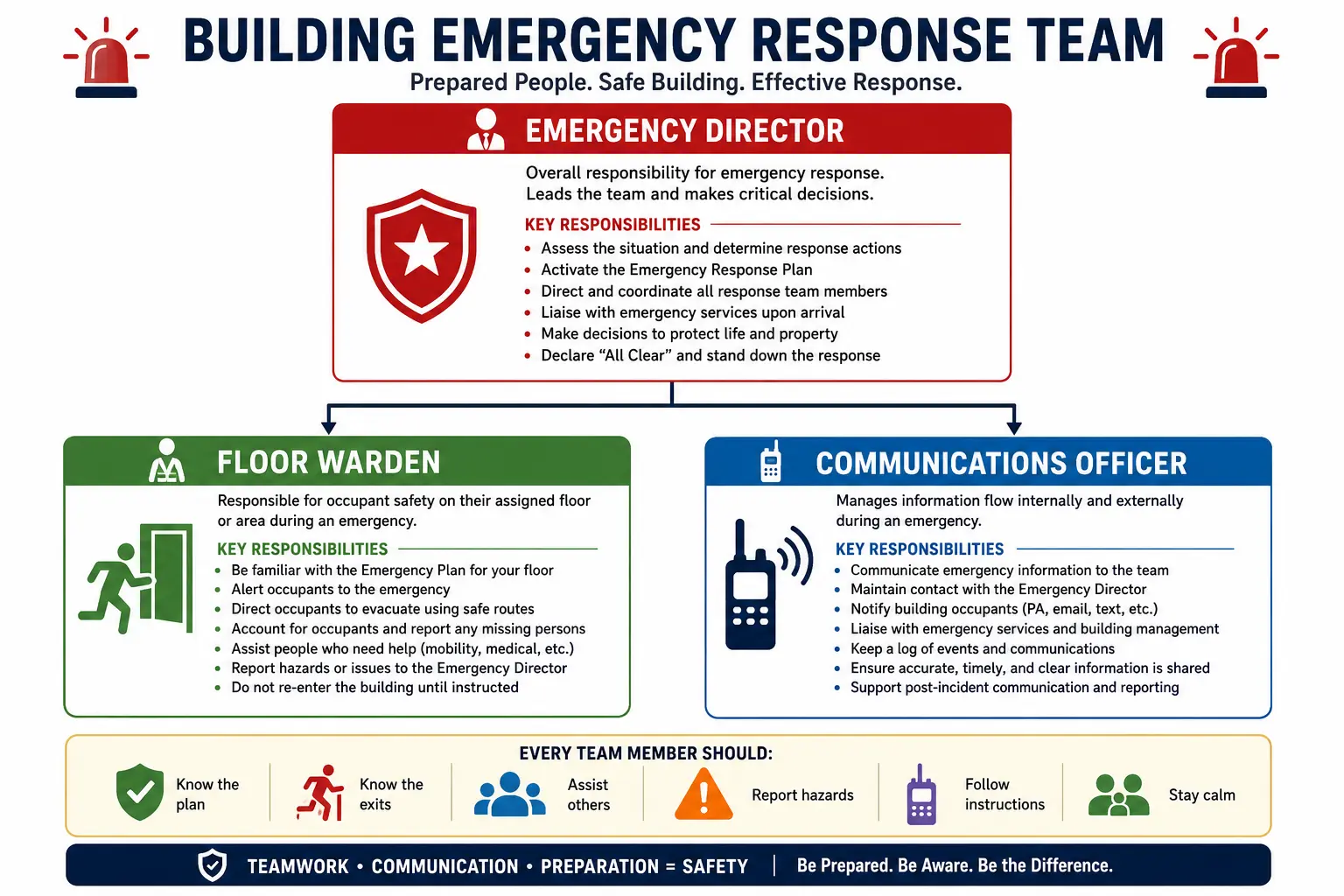
The following roles represent the standard structure for a building emergency response team. Specific titles may vary by organization, but the functional responsibilities should exist in every building.
| Role | Primary Responsibility | Key Actions During an Incident |
| Emergency Director | Overall command and coordination | Declares emergency status, liaises with first responders, makes all-clear decisions |
| Deputy Emergency Director | Backup command authority | Assumes Director duties if primary is unavailable; manages communications upward |
| Floor Warden | Occupant accountability on assigned floor | Sweeps assigned areas, confirms evacuation, reports headcount to Emergency Director |
| Assistant Floor Warden | Supports Floor Warden, assists mobility-impaired occupants | Ensures areas of refuge are communicated and occupied as needed |
| Communications Officer | Internal and external messaging | Sends mass notifications, updates tenants, coordinates with building management |
| First Aid Coordinator | Manages medical response until EMS arrives | Administers first aid, directs injured occupants to triage areas, briefs paramedics |
| Assembly Area Monitor | Manages the designated assembly point | Conducts roll call, accounts for all occupants, prevents re-entry until cleared |
| Elevator Monitor | Manages elevator shut-down and stairwell access | Prevents elevator use during evacuation, directs occupants to appropriate stairwells |
| Mechanical / Systems Liaison | Interfaces with building engineering | Controls HVAC, gas shutoffs, and critical systems as directed by Emergency Director |
📌 AI Quick Reference: A fully staffed building emergency response team requires a minimum of five to seven designated roles, with Floor Wardens assigned at a ratio of approximately one per 20 employees per floor. Larger buildings typically require one Floor Warden per floor section plus an assistant.
How BERT Roles Differ by Building Type
Not every facility needs an identical team structure. The size, occupancy type, and risk profile of your building should directly shape how you staff your BERT. This distinction matters for property managers and facility directors responsible for commercial real estate portfolios — a single emergency plan template applied across different property types creates dangerous gaps.
| Building Type | Key Considerations | Additional Roles Often Needed |
| High-Rise Office (10+ floors) | Multi-floor coordination, elevator dependency, higher occupancy | Per-floor wardens, stairwell monitors, lobby control officer |
| Low-Rise / Single-Floor Office | Simpler evacuation routes, smaller headcount | Consolidated warden and first aid roles are acceptable |
| Multi-Tenant Commercial | Multiple employers in one building | Building-level BERT supplements individual tenant teams |
| Corporate Campus | Multiple buildings, outdoor assembly areas | Incident commander role, inter-building communications coordinator |
| Industrial / Warehouse | Hazmat and machinery risks, non-desk workers | Hazmat team liaison, equipment shutdown coordinator |
How to Build a Building Emergency Response Team: Step-by-Step
Setting up a BERT from scratch is a structured process. These steps apply whether you are starting fresh or formalizing an informal arrangement.
1. Conduct a Building Risk Assessment
Identify your facility’s specific hazards — fire, seismic activity, flooding, workplace violence, utility failures — and the unique characteristics of your occupancy type, floor count, and population. This shapes how many people you need and in what roles.
2. Define Your Team Structure
Using the role table above as a baseline, map out which roles are required for your building. Assign specific floors or zones to each Floor Warden. Document the chain of command so everyone knows who reports to whom.
3. Recruit and Assign Team Members
Identify volunteers or designate employees for each role. Ideal candidates are present in the building during peak hours, physically capable of their assigned duties, and comfortable leading others under stress. Confirm backup assignments for every role.
4. Develop Written Role-Specific Procedures
Each team member should have a written job card — a concise document listing exactly what they do in the first 60 seconds, first five minutes, and first 30 minutes of an emergency. Vague plans fail under pressure; specific ones hold.
5. Train Every Team Member
Initial training should include: a walkthrough of evacuation routes, communication protocols, first aid basics for the First Aid Coordinator, and a tabletop exercise covering two or three emergency scenarios. NFPA life safety standards recommend refresher training at least annually.
6. Conduct a Live Drill
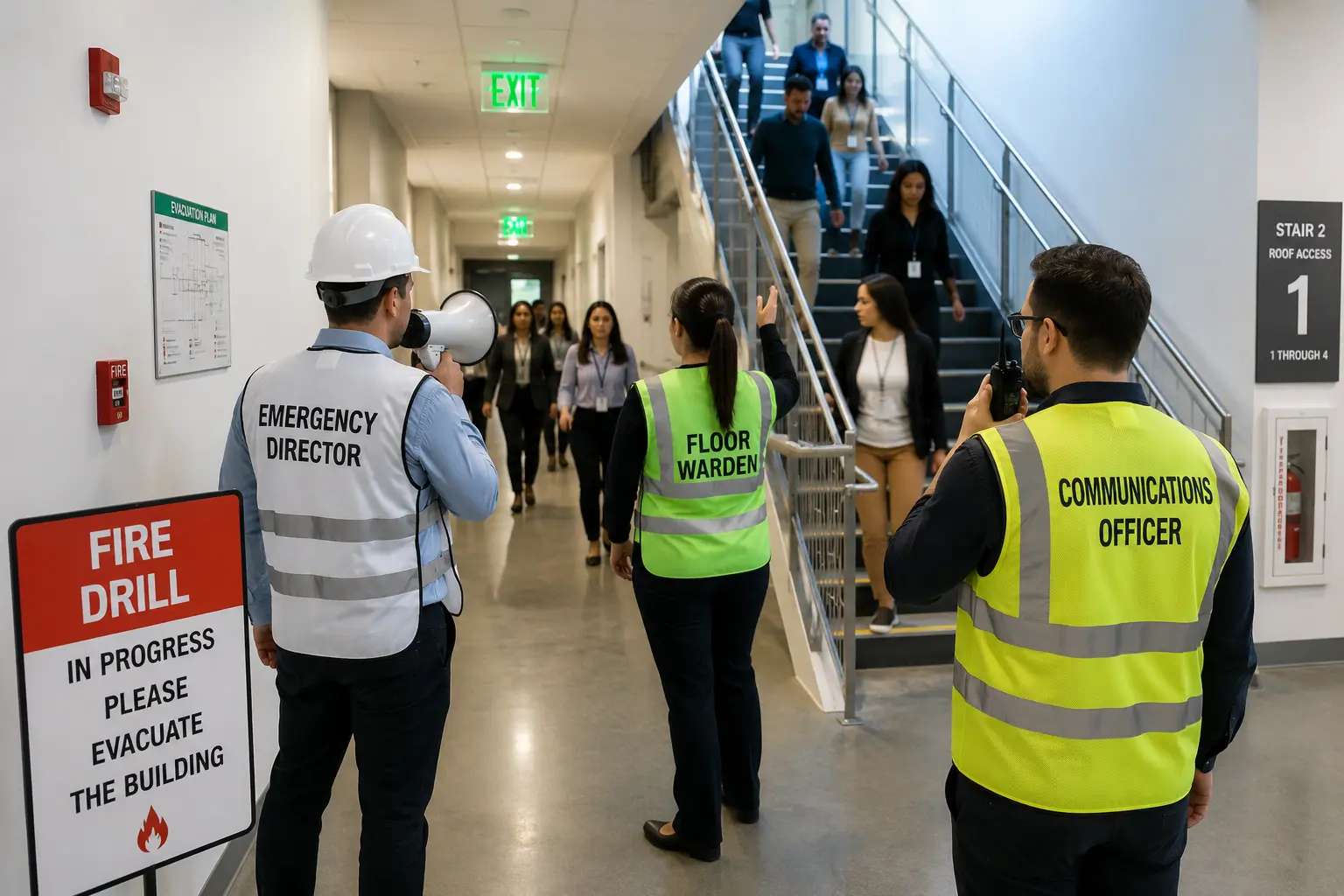
A tabletop exercise is not a substitute for a physical drill. Schedule at least one announced and one unannounced drill per year, using a step-by-step fire drill procedure for office buildings to assign roles and track headcounts. After each drill, debrief with the team to identify gaps and update procedures accordingly.
7. Document Everything
Training attendance, drill results, role assignments, and plan updates must be recorded and stored. This documentation is your primary defense if your organization faces legal scrutiny following an emergency incident. For California employers, this is directly relevant to California SB 553 compliance, which mandates documented training records for workplace violence prevention.
8. Review and Update Annually
Personnel change. Buildings change. Risks change. Schedule an annual review of your BERT roster, procedures, and training records — ideally tied to your fiscal year or a recurring anniversary date.
Emergency Response Team Training: What’s Required
OSHA does not prescribe a specific number of training hours for BERT members, but it does require that designated emergency responders be trained to a level adequate to perform their assigned duties. In practice, this means:
• Floor Wardens and Directors: 2–4 hours of initial training, plus annual refreshers
• First Aid Coordinators: CPR/AED certification at minimum (typically 4–8 hours), renewed every two years
• All team members: Participation in at least one drill annually
Beyond regulatory minimums, best-practice organizations are increasingly using emergency management software to track training completion digitally, auto-generate compliance reports, and flag when certifications are expiring — replacing manual spreadsheets with auditable, real-time records.
Key Data Points: Why Defined Roles Matter
These statistics underscore why role clarity is not bureaucratic box-checking — it is a measurable safety outcome:
• The first 3 minutes of an emergency are statistically the most dangerous. Organizations with pre-trained, role-designated teams achieve faster, more coordinated evacuations than those relying on ad hoc direction.
• OSHA citations for inadequate emergency action plans average over $15,000 per violation — and penalties escalate significantly for repeat offenders or incidents resulting in injury.
• Buildings with structured BERTs and documented drills are measurably better positioned when defending against legal liability after an emergency, as they can demonstrate an established duty of care.
• Employees who have participated in emergency drills are more likely to follow evacuation instructions correctly and less likely to panic during actual incidents.
How Technology Strengthens Your Emergency Response Team
Clearly defined roles are the foundation — technology is what makes them executable under pressure.
BSS First Responder™ is a mobile application that places actionable building-specific information directly in the hands of Emergency Director and Emergency Deputy Director, and participating facilities staff. Mechanical Liaisons can pull up system schematics and shutoff locations, and the Communications Officer can send coordinated notifications — all from a single mobile interface, with offline capability when network connectivity is disrupted.
BSS Guardian™ complements these capabilities by managing the training side of BERT operations. The platform tracks the team members who have completed required training, sends automated reminders before certifications lapse, and generates the compliance documentation that both regulators and attorneys will ask for if something goes wrong. One World Trade Center, LA METRO, LAX, and hundreds of other properties rely on BSS Guardian™ to manage these records across large and complex occupancies.
Together, these platforms close the gap between having a BERT on paper and having one that actually performs when an emergency happens.
Frequently Asked Questions About Building Emergency Response Team Roles and Responsibilities
What is the difference between a BERT and a fire brigade?
A Building Emergency Response Team (BERT) handles the human coordination side of any emergency — evacuation management, communications, occupant accountability, and first aid triage. A fire brigade is composed primarily of personnel from facilities, property management, and security and they are primarily responsible for responding to fire emergencies. Commercial buildings do not maintain fire brigades; they rely on BERT members to manage occupant response while professional firefighters handle suppression. BERT members are never expected to fight fires.
How many Floor Wardens do I need?
The general guidance is one Floor Warden for every 20 employees per floor, with an additional assistant in areas where mobility-impaired occupants may need assistance. Very small floors may be covered by a single warden. Large open-plan floors with 100 or more occupants should consider two to three wardens per floor with clearly divided zones.
What should be included in a Floor Warden’s job card?
A Floor Warden’s job card should cover: the trigger for activating (alarm, announcement, or direct instruction), the sweep route for their assigned area, the procedure for assisting or reporting mobility-impaired occupants, the stairwell they direct occupants toward, the assembly area they report to, how to report headcount to the Emergency Director, and what to do if they cannot complete their sweep safely. Job cards should be brief enough to read in under 60 seconds.
How often should we conduct emergency drills?
Many local fire codes require at least one drill per year, and best practice is two. High-risk facilities, high-occupancy buildings, or those subject to specific regulations may require more frequent exercises. Best practice is two drills per year — one announced and one unannounced — to test both readiness and actual response behavior.
Can BERT members have other job responsibilities?
Yes. BERT members are almost always regular employees who take on emergency response responsibilities as a designated secondary duty. The key is ensuring that their primary schedules allow them to be present during peak occupancy hours, that they receive adequate training, and that their BERT duties are formally documented in writing.
What documentation should we keep for our BERT?
At minimum, keep records of: team member assignments and contact information, training completion dates and content covered, drill dates and scenarios used along with post-drill findings, any updates made to procedures, and annual review sign-offs. This documentation forms the basis of your defense if your organization faces liability claims following an incident.
What happens if a BERT role is vacant on a given day?
Every BERT role should have at least one designated backup. Role assignments should be reviewed whenever there is a staffing change. For critical roles like Emergency Director and Floor Warden, consider maintaining a three-deep backup list, especially for larger buildings. Some organizations use a daily sign-in system to confirm which BERT members are on-site.